Terug naar hoofdinhoud

The Song of Songs

Source: Prog, nr.99, 2019-06, p.88-91
Author: Mike Barnes

The Song of Songs

“Florian was more interested in how, over the history of mankind, people gathered over religious lifestyles and then created music. And so he studied Buddhism, Hinduism, he also studied the Bible”

Enigmatic krautrock pioneers Popol Vuh continue to intrigue fifty years on from their inception. Prog lifts the lid on their enthralling career...

Out of all the groups active in Germany in the so-called 'krautrock' scene of the late '60s into the '70s, Popol Vuh were the most mysterious and enigmatic. With their exploration of the transcendental in electronic and acoustic music they had little overlap with rock, and stylistically found themselves set apart from their peers. The group's founder and sole constant member, keyboard player Florian Fricke, was musically active until his death in 2001, but he had rarely been interviewed for the UK music press and many releases flew under the radar.

But now BMG are beginning a reissue campaign with The Essential Album Collection Vol. 1 on CD and vinyl box sets, remastered by Frank Fiedler from the original line-up and latterday Popol Vuh member Guido Hieronymus. An image had formed around Fricke of a shadowy, almost hieratic figure, inhabiting a rarefied creative space in which he made his avowedly spiritual music, while also contributing soundtracks to films by the German film director Werner Herzog.

Fiedler remembers him rather differently:

"Florian was a very good worker - he could see a whole project through to a good end. He was a family man, too. He liked to cook, he liked to go to restaurants, drink wine and be in good company, laughing and relaxing. And when he had money he was very generous."

In 1969 Fiedler was a student at the Berlin Film Academy and was hired by a young woman from Munich as a cameraman for a portrait of the film director Pasolini. He went to her apartment in Munich where Fricke was also a guest.

"I met him more and more, and we started to get into deeper discussions as to what is going on in the world," says Fiedler. "We both read the Popol Vuh, the book of the K'iche' Indians [of Guatemala, which includes the Mayan creation myth]. The title was hanging in the air, and so the project's name became Popol Vuh."

Born in 1945 in Kiel on the north German coast, Fiedler recalls that as he and his young peers reached maturity they rebelled against the older generation, who they saw as being stuck within narrow ways of thinking.

"We had longer hair and smoked hashish," he says, laughing. He also recalls the liberating effect of '60s rock and pop music, particularly from England, and the thrill of seeing Jimi Hendrix play at the Star Club in Kiel. "We grew up with this evolution of rock music and a rich and colourful hippie movement," he says. "It was, in many ways, a desperate cry for freedom, certainly here in this country after all the humiliation of wartime."

Fricke had studied piano at Munich Music High School. "It was his intention to go beyond what the pop music was offering," says Fiedler. "What Florian did was a kind of a crossover between timeless classics and the new freedom of pop, rock and jazz."

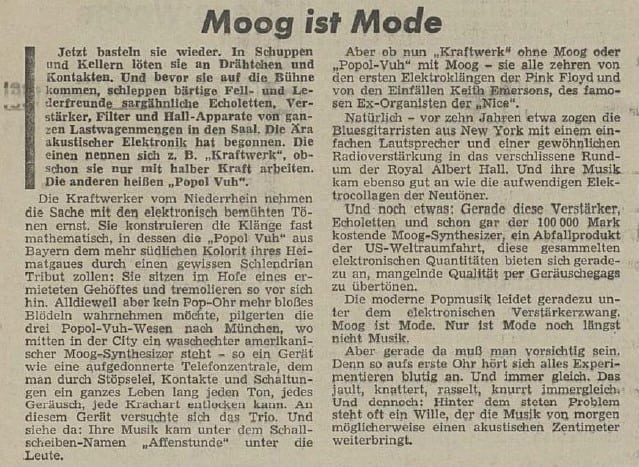
To add to the newness of his music, Fricke had acquired a Moog III and began working with Fiedler in autumn 1969 on Popol Vuh's debut, Affenstunde, which was released in 1970 and named after a chapter in the Popol Vuh about the rise of humankind. Much of Side One was recorded on a two-track Revox reel-to-reel in a farmhouse near Miesbach in the foothills of the Bavarian Alps, which belonged to the family of Fricke's wife, Bettina.

The credits for the album are Fricke on Moog, Holger Trülzsch on percussion and Fiedler on 'Synthesiser mixdown'. So what exactly was his role?

"Every good artist needs a counterweight," says Fiedler. "Florian was the instrumentalist and responsible for composition, but he worked more out of his intuition in terms of getting the sounds from those four black boxes that were in front of him, and I helped him because it was so complex. I did the filtering mostly. You couldn't programme that machine, you had to move the control knobs and put the modules together with cables."

Popol Vuh's Moog music didn't sound like anyone else's - it had a strange eerie tone and there was an undulating, serpentine flow to the melodies pitched somewhere between signalling and singing, its rhythmic complexity enhanced by the use of a sequencer and echo and delay during mixdown sessions.

"It was Florian's idea for a soprano voice [effect] and to get the filtering to take it away from a hard electronic sound, to get more of a human sound. I mean, you could do things with a Moog III that really were painful. That was a problem with that machine, you had to filter to get the sound he envisaged out of it."

Fiedler feels that on the title track of In Den Gärten Pharaos (1971), "We really got that sound to the peak." Side Two of the album is a colossal church organ piece, Vuh, which Fricke recorded in a former monastery church in Baumburg, Bavaria.

Fricke guested playing Moog on Tangerine Dream's 1972 album, Zeit, but Popol Vuh's next album, Hosianna Mantra (1972) featured a predominantly acoustic chamber ensemble of piano, guitar, oboe, tamboura and a real soprano, Korean singer Djong Yan. In situations like these, when Fiedler's technical expertise was not needed, he would continue his career as a film cameraman.

Hosianna Mantra is full of melody, with a radiant sound like light shining through stained glass. It also demonstrated that even in the group's more expansive moments, Fricke was beginning to strive towards a clarity of expression.

Fricke has described his own creative process thus:

"The path to creation is like walking on a small path. It begins without intention, purposeless, yet a goal arises. I say yes and approach the goal. I forget it again, but the goal starts to be more and more alive in me and I move steadily towards it, to receive it. It is me, who is moving. This is my collaboration, my devotion, which fills my person totally with an undivided attention. And I feel the power within, focused on the goal. This is the path to a small path."

Popol Vuh evoked similar atmospheres on Seligpreisung (1973) - the first album featuring guitarist and drummer Danny Fichelscher with Djong Yun singing lyrics derived from the Gospel Of Matthew, also recorded in the church in Baumburg - and on Einsjäger Und Siebenjäger (1974).

The implications of the different religious elements in the title 'Hosianna Mantra' has prompted some to claim that Fricke converted to both Christianity and Hinduism.

"No..." says Fiedler, clearly surprised at the idea. "Fricke never converted to any religion. He was Protestant from his family, but his idea was not to worship from a religious background. He was more interested in how, over the history of mankind, people gathered over religious lifestyles and then created music. And so he studied Buddhism, Hinduism, he also studied the Bible, but he took the Martin Buber translation in Hebrew, which is much more direct and powerful than our German translation of the Latin Bible."

But Popol Vuh's music does seem religious at times.

"Yes, it seems..." Fiedler replies. "But if you also take the movie music, you get another picture of Florian's intentions."

Two of the soundtrack albums that Popol Vuh made for Herzog that are included in the current box set are Aguirre (1975) and Nosferatu (1978). The former is characterised by Fricke's use of the instrument he called the "choir organ", a Mellotron-like device that utilised taped recordings of voices. Its unearthly sound contributes to the unforgettable opening sequence of Aguirre: Wrath Of God, in which hundreds of conquistadors snake down a steep mountain pass. There are a number of variations on this opening theme, some with percussion and some with pulsing Moog, and although the album is padded out with some earlier outtakes and a lengthy, eerie Moog piece Vergegenwärtigung, none of which are used in the film, it's still a coherent collection.

Nosferatu features the ghostly ritual chorales of On The Way, which Herzog used in the film to chilling effect. Again, the album is a mix of previously released and new recordings, haunting folk-like and Eastern-sounding pieces featuring the sitar and tamboura, Eno-ish still-lifes and some uncanny electronic pieces. Fiedler recalls Moog sessions in the mid-'70s in Fricke's house in Munich for the soundtrack when he and Fricke experimented with deep bass frequencies to underpin the instruments.

Did Herzog have any input into this soundtrack music?

"He didn't," Fiedler replies. "He liked Florian's compositions so much because they fitted his intention in telling a story. He didn't check [the tape], he just came and he took it and got it to the editing table."

Popol Vuh continued supplying music for Herzog until Cobra Verde in 1987 and released new music until 1999, some of which explored Fricke's fascination with chants, breathing techniques and overtone singing, including Agape-Agape/Love-Love (1983) with Renate Knaup of Amon Düül II as one of the vocalists. Fricke also recorded the multi-vocal I Am One With The Earth, a limited pressing solo album recorded in an old basilica in 1983.

In 1995 Fiedler and Fricke branched out, making a movie, Kailash: Pilgrimage To The Throne Of Gods, about the sacred Tibetan mountain, which eventually came out as a DVD, a soundtrack CD and a CD of unheard piano tracks in 2015. Some of this material was reworked for Shepherd's Symphony, which also featuring Guido Hieronymus on keyboards and guitar (1997) and moved towards ambient trance. In that year Popol Vuh also produced A Train Through Time, based on a drum sample of Danny Fichelscher which appears as a bonus track on Affenstunde.

Shortly before Fricke's death at the age of fifty-seven, he and Fiedler had made a multimedia operatic production called Messa Di Orfeo, which was performed in Southern Italy at the Time Zones Music Festival, firstly at Molfetta in 1998 and then the following year. "We performed in the old Rocca Malatestiana fortress in Fano with a thirty-piece choir and a gigantic movie projection," Fiedler says. Sadly, that was to be their last collaboration.

Fiedler supervises the Popol Vuh tape archive, and as well as BMG releasing the remastered albums there will be a Popol Vuh anthology including unreleased material and a release of "new Popol Vuh mixdowns in collaboration with some electronic musicians".

There is also a work in progress, now nearing completion, designed to help keep his friend's name alive.

"There are piano tracks and Moog III tracks that I gave to Guido and he composed for them," Fiedler explains. "His wife, Biljana Pais, wrote lyrics and she has a fantastic gospel voice, and so we suddenly had a project: the name is Popol Vuh Beyond and the title is Requiem For Florian. It has been an interesting experience to see it grow."
Lees meer …The Song of Songs

Popol Vuh (Empire)

Source: Empire, nr.3, 2019, p.50-51
Author: Tim Stecher

Popol Vuh

Der Backkatalog der Krautrock- und Elektronik-Pioniere Popol Vuh wurde von BMG in Zusammenarbeit mit den Popol Vuh-Mitgliedern Frank Fiedler und Guido Hieronymus aufwändig remastert. Die Essential Album Collection wird nun in mehreren Teilen neu auf CD und LP veröffentlicht. Der leider viel zu früh verstorbene Florian Fricke prägte die Geschichte von Popol Vuh entscheidend, als die Formation die Musik für einige Filme seines Freundes, des Filmregisseurs Werner Herzog, komponerte und damit große Erfolge feierte. Es ist wichtig, dass die Musik von Popol Vuh in neuem Glanz erstrahlen kann und mehrere Generationen von interessierten Musikhöhern wieder neu begeistern wird. Tim Stecher hatte die Gelegenheit, mit Gründungsmitglied Frank Fiedler über die Geschichte von Popol Vuh, die Essential Album Collection und weitere Projekte zu sprechen.

Mit The Essential Album Collection Vol.1 liegt eine erste Sammlung von fünf Popol Vuh-Alben in remasterter Form mit jeweils ein bis zwei Bonustracks und neu gestalteten Booklets vor. Wie kam es zu dem Projekt, den Katalog von Popol Vuh zu überarbeiten?

- Wie ich feststellen könnte, wird das Werk von Florian Fricke doch bei vielen, besonders den Kennern und auch international, hoch geschätzt. Ihm wohnen offenbar zeitlose ästhetische Qualitäten inne. Dieser Klang betört einfach. Und auch bei so einem Mediengiganten wie BMG scheint man das Potential dieses Werkes gesehen zu haben.

Welche Studioalben werden bei der Essential Album Collection Vol.1 enthalten sein?

- In den Gärten Pharaos, Seligpreisung, Das Hohelied Salomos, Letzte Tage – Letzte Nächte, Brüder des Schattens, Söhne des Lichts und Die Nacht der Seele.

Sie waren neben Florian Fricke zwar ein langjähriges Mitglied von Popol Vuh, waren aber nur an einem Teil der Studioalben musikalisch beteiligt. An welchen Produktionen haben Sie neben den ersten Alben aktiv mitgewirkt?

- Wenn ich mich recht erinnere, an Affenstunde, In den Gärten Pharaos, Das Hohelied Salomos, Agape-Agape, Die Erde Und Ich Seind Eins, For You And Me, Florian Fricke Spielt Mozart, City Raga, Sing For Song Drives Away The Wolves, Shepherd’s Symphony und Messa Di Orfeo. Nach Florians Tod in Zusammenarbeit  mit seinem Sohn Johannes Fricke-Waldthausen noch an Popol Vuh Revisited & Remixed und Kailash: Pilgrimage To The Throne Of Gods (CD & gleichnamige Film-DVD). Und natürlich an der Popol Vuh-Gesamtherausgabe Anfang des Jahrtausends bei SPV und jetzt mit einigen Neuerungen bei BMG.

Wie würden Sie die sehr unterschiedlichen Alben Affenstunde, Hosianna Mantra, Einsjäger & Siebenjäger, Aguirre und Nosferatu jeweils in wenigen Worten beschreiben?

- Ich mache einen Spiegel, Kyrie Eleison – Allmächtiger, erbarme dich… Kampfkunst – Flügel vs. E-Gitarre….. Abbild verstiegenen Wahns… Poetischer Blutsauger ….

War das Phänomen und Potential der Musik von Popol Vuh erkennbar, als Sie mit Florian Fricke zusammenkamen und mit Affenstunde ein Debütalbum aufnahmen, mit dem ganz neue, freie, verspielt-betörende Klangwelten entwickelt wurden?

- Na, wir wussten schon, dass wir was drauf hatten. Fragte sich nur, wie weit es ging. Das Album Affenstunde und auch In Den Gärten Pharaos sind ja heute noch eine musikalische Herausforderung erster Güte und haben eine ganz eigene Schönheit. Das hat ja keiner je wieder so gemacht, das war ein einmaliger Höhenflug. Wenn man so will, die Verwirklichung unserer Sehnsucht nach Licht und Weite.

Wie erklären Sie sich den Erfolg von Popol Vuh und die Tatsache, dass die Band heute als Klang-Pionier der Elektronik- und Krautrock-Musik gillt, die eine Vielzahl von Musikern der letzten 30 bis 40 Jahre in deren Entwicklungen maßgeblich geprägt hat?

-  ‘Erfolg’ is ein großes Wort. Für Florian zum Beispiel bedeutete es zwar einigen Ruhm, aber viel zu wenig Geld, um sich wirklich frei bewegen zu können. Und auch ich habe doch nur überlebt, weil ich als Kameramann recht gut Geld verdienen konnte. Besonders für Florian war es kein einfacher Weg. Popol Vuh ist vor allem Florians Einfallsreichtum zu verdanken und seine Liebe zur Klanggestaltung. Ich meine, wir haben Dostojewski und Govinda gelesen, haben mit unseren Frauen die Welt bereist und dabei diese Klänge auf Schallträgern festgehalten. Wohl im Ganzen etwas, das man ‘erfüllt’ nennen kann. Gut, diese Klänge gingen tatsächlich auch um die ganze Welt. War wohl was dran…

Einze Zitat in dem Biografie-Teil der neuen, informativen CD-Booklets hat mich besonders beeindrückt: “Popol Vuh are the greatest idols that I ever had and will ever have”, Michal Cretu. 1992. Was bedeutet Ihnen ein derartiges Zitat?

- Das ist wirklich ganz lieb von Michael..

Die Schaffung der wunderbaren Soundtracks für Filmwerke von Werner Herzog wie zum Beispiel für Aguirre und Nosferatu waren weitere Highlights in der musikalischen Vita von popol VUh. Wie kam es zu den Porjekten und wie verlief die Zusammenarbeit?

- Man muss wissen, dass sich Werner und Florian schon aus ihrer Jugenzeit kannten. Florian hat schon die ersten Filmstolperer von Werner mitgemacht. Da waren sie 17, 18 jahre alt. Sie waren ohne späteren Ruhm schon befreundet. Und so hatte jeder immer Kenntnis vom künstlerischen Werdegang des anderen. Darüber hinaus verstanden sich die beiden eben auch über ihre Auffassung von künstlerischen Ästhetik, ihrem Medien-Feeling, und so war es fast natürlich, dass Ihre Werke verschmolzen.

Was waren aus Ihrer Sicht die späten Höhepunkte in der Diskographie von Popol Vuh?

- Eigentlich sehe ich da nur Messa di Orfeo. Diese Klangskulptur mag nicht so ganz einfach zugänglich sein, hat aber für mein Gefühl eine besondere Art seelischer Tiefenfärbung, wobei ein Bogen zu unseren ersten beiden LPs entstand.

Mit Florian Fricke, der 2001 leider viel zu früh verstarb, ging auch die Geschichte von Popol Vuh zu Ende. Sind Sie weiterhin musikalisch aktiv?

- Allein schon meine Filmarbeit ist immer mit viel Musik verbunden. Ich habe jetzt aber mit Guido Hieronymus der unsere Studioarbeit ja seit Ende der achtziger Jahre begleitete, eine ganz eigene Musik-Idee verwirklicht. Wir nannten es ‘Popol Vuh Beyond – A Requiem for Florian’. Wir spielen mit dem Verstorbenen. Mit Florian Klavier- und Synthie-Tracks sind ganz neue Klänge entstanden, eine neue, vibrierende Weltmusik. Man wird sehen..

Gibt es nach der Veröffentlichung der überarbeiteten Studioalben von Popol Vuh noch weitere musikalische Schätze aus dem Wirkungskreis von Popol Vuh, auf die wir uns freuen können?

- Nun, dies war The Essential Album Collection Vol.1 was, wie oben erwähnt, ja erkennen lässt, dass da noch etwas nachkommt. Und zwar Vol.2 und Vol.3, die Essenz, weitere Meisterstücke… Das wird Herbst 2019 und Frühling 2020 sein. Besonders in der letzten Staffel wird auch einiges neue Material dabei sein. Junge Elektroniker spielen gerne mit Extrakten alter Popol Vuh 24-Spur-Studiotracks. Auch wenn ganz andere musikalische Vorstellungen herrschen, bleibt ein Zusammenwirken mit Florians Musikauffassung offenbar auch für diese Jüngeren interessant und bringt etwas. Und dann Florian hat an die zweihundert Musikstücke komponiert und veröffentlicht. Uns schwebt da eine Art Anthologie der allerschönsten Kompositionen vor. Vielleicht im Zusammenhang mit bisher unveröffentlichten Klavier-Schwärmereien Florian: Das ist noch nich endgültig.


Lees meer …Popol Vuh (Empire)

Siegfried Arising

Source:: Phonograph Records Magazine, 1972-05, p.18-20
Author: Duncan Fallowell

SIEGFRIED ARISING
A REPORT FROM GERMANY ON ABSTRACT EXPRESSIONISM IN ROCK MUSIC

'Whatever happened to Crazy Otto? I said. No one knew.  ‘And Bert Kaempfert? and what´s-his-name? Horst Jankowski? Walk in the Black Forest, remember? No one did. Well, how about the Rattles?’

That´s better. A Hamburg group who toured with the Beatles and had a hit in England not too long ago with The Witch. And what else? Mmmm… In which case how do you explain some of these amazing albums set forth by major record companies these days? By German groups. And pretty amazing. These things don´t happen in a vacuum. Besides what about that other Crazy Otto - Otto Muehl? Banned from the National Film Theatre because he wanted to chop up live chickens on stage. And his films? Made the Wet Dream Festival seem like tea at the Ritz. Oh, he´s Austrian, I see, OK, Werner Schroter and Rosa von Praunheim instead. Mister Rosa and Sisters of the Revolution. Gay militants. And what about the Dusseldorf artists who scandalized and delighted the Edinburgh Festival in 1970? What do you know about them? Mmmm…. Obviously something´s afoot in ol´ Germany and I don´t mean jackboots. Shouldn´t someone go and look, Yes, me.

But somehow Germany doesn´t exist as a country and never really has. Which no doubt explains all that nebulous but inspiring chat about the Fatherland some time back. In the absence of a Hitler to invoke the Teutonic ghost, local loyalties pull stronger than national ones, something encouraged by the slicing the country in two with Berlin as an exotic haunting schizoid symbol of it all. Naturally enough the underground follows this federal pattern and only by visiting every city might one tap all that goes on. There is no absolute center of gravity in Germany, no one pivot point to concentrate its energies - apart, that is, from the Mighty Mark. Berlin should have become this but its situation is unique, a nervously energetic city doomed to exist in an iron lung. German groups love it and leave it - like fixing heroin, a mad exhilirating high one might well do without. But it does have some incredible bands: Ash Ra Temple, who play huge amplified urban ragas and manage to generate the most staggering noises from the simplest equipment; or Tangerine Dream, led by Edgar Froese, whose concert at the Kongresshalle was attended by ghosts of Kafka and Aleister Crowley - experimental rock at its most succulent and unnerving. Berlin is also the headquarters of the Ohr Record Company, Germany´s only independent progressive label, which puts out a lot of extraordinary stuff, much of it violently uncommercial.

This decentralization of activities in Germany does have some advantages. No one is uncomfortable about not being “where it´s at” since in Germany “it” is nowhere in particular. Unlike Britain where young bands feel inadequate or over-enthusiastically provincial (visions of the Troggs in Andover) if they don´t make it in the metropolis, Germany spreads its groups, agencies, studios and record companies ´round and about. Hamburg - sailors and sin and the most ingenious porno - used to be quite a place, but has lately been living off memories of the Beatles and the Star Club. With a new band,  Frumpy, and the opening there of a joint agency by EMI, Kinney, CBS and God knows who else, it is apparently reviving. But Munich seems the liveliest spot at the moment, though this may be fortuitously due to the presence there of Germany´s biggest Group, Amon Duul II and their entourage. Or even the long lost Abi Ofarim who runs a promotional company in the town. Nurnberg claims Ihre Kinder and Improved Sound Limited, the most un-Germanic German Group I came across. They want to sound  “American”, but since I don´t really know what that means I couldn´t tell them if they did. Dusseldorf has Annexus Quam. Cologne has the Can and Floh de Cologne. Bonn doesn´t have anything at all.

This particularism is reinforced by local television which goes out at peak viewing time (8-10) and local radio which features local bands. The groups are attached to their home grounds almost like football clubs. AD II say Cologne is ´a gloomy city´ and for the Can, Munich is ´one huge boutique´. Rarely does one German band praise another. Chris Karrer of AD II says that the groups have a lot to learn from each other but rarely come together. This lack of a collective identity raises problems. In any society there are only a certain number of people with the flair and elan to get new ideas across and if they are spread too widely their work is, of necessity, enervated. Maybe this is why AD II and the Can have taken so long in becoming known beyond Germany. Both groups were founded in 1968 but because they are apparently so elusive, agencies abroad don´t push them as much as they might. This is exacerbated by a German law which effectively prohibits managers and although the big recording units can circumvent this prohibition, new groups have to struggle along organizing contracts, bookings and publicity themselves. Not only are they often temperamentally unsuited to such tasks but it draws off time and energy from their main work - music. AD II are lucky in having in addition to the sleek UA machine based in Munich, someone like Olaf Kubler to play father to them. An ex-musician himself, he is also one of the best producers of ‘progressive sound’ in Germany and seems to thrive on it. Nonetheless two British tours  planned for Amon Duul II have collapsed because of weak organization, although it seems likely that the Can will play in England this summer.

Germany has one big TV pop show, “Beat Club”, which everyone watches but, until recently heavily  relied on Anglo-American acts. A for magazines there is nothing to compare to, say, OzMelody Maker is widely read but it arrives a week late which frustrates impatient spirits. The best (in fact the only) progressive music paper is Sounds (no relation to the abysmal English tag of the same name). Again it is mostly full of English and American news. Rolling Stone can be ordered from London but it is not sold on the streets. Because of the lack of an underground press as we know it many people seem to know more about what is happening over the water than in their own country. The underground papers which do exist are put out by student or worker communities or by school kids and serve only local catchment areas. The schools (13 to 19 years) are a particular surprise, though. They are building up their own underground institutions and people take notice. Some bands prefer school children as audiences, not in a teenybopper sense, but because they seem naturally turned on. Like kids everywhere they are beginning to take for granted attitudes which the 20-30 generation have had to evolve into over the past decade. In Germany they are especially articulate. Maybe having Herman Hesse as a standard school text helps.

It was useful from my point of vies to find them so knowledgeable in English affairs. I only knew one German word, istigkeit, which is handy in discussing Huxley but has a rather lugubrious effect if repeated to often. Anyway they all spoke English embarrassingly well and despite smoking a hell of a lot, they are very clear-headed and almost stereotypically thorough in their ideas. Several English groups - Man, Megaton, Nectar - could not survive without Germany and a good many more play there regularly. On the other hand, The Stones´ and Led Zeppelin tours some time ago failed to create the expected frenzies, perhaps because they were launched with a certain patronizing attitude.

My own curiosity about the new German Music was originally aroused by Can´s MONSTER MOVIE album, released in England in 1970. After AD II, they are Germany´s biggest band and most competent. They used to be considered a studio group, since they spent much of their first two years away in a castle, Schloss Norvenich, familiarizing themselves thoroughly with their sound and with each other. Now, with their new double album behind them, TAGO MAGO, they are concentrating on live rock shows. To me they are the archetypal German rock band: fierce, strange, extremely intelligent, and just plain heavy. In an age of heavy bands they are the heaviest I´ve come across, not like Cream or Led Zeppelin but in their own way which is difficult to describe. The Stooges on a trip? The Velvet underground in Valhalla? King Crimson minus the schmalz (my other German word, I forgot)? Pink Floyd in black leather? Yes, sort of. But not really. Listen to MONSTER MOVIE or TAGO MAGO a few times. It´s really a totally new rock experience. And since a great many people obviously need a totally new rock experience one wonders why they´ve been so lazy.

The Can includes Damo Suzuki (voice), Jacki Liebezeit (drums), Michael Karoli ( guitar), Irmin Schmidt (organ) , Holger Czukay (bass). Damo is not the voice on MONSTER MOVIE. That was a Black American called Malcolm Mooney who got rough and was shipped back to New York. A series of auditions followed but all singers were too good. Then they found Damo - who´s Japanese, speaks little English and no German - singing strange things in a Munich street. He turned out to be perfect.

Irmin studied under Berio and Stockhausen and hung around the Vienna Symphony Orchestra. Then he saw a different light and decided to form a rock band of his own kind. Although, in his attitudes, here has been a strong reaction against his bourgeois past, he has inherited much of the Stockhausen creed whose belief in chance, sublimation through sound, depersonalization of the composer through the freedom allotted performers. He also has the assurance of the classical musician who knows exactly how to use his tools to his own ends. Holger is also ex-Stockhausen and is exceptionally knowledgeable in Electronics. Jacki  comes from jazz and Michael is a friend of Holger from his time at college. The Can as a whole are intensely meticulous, controlling their music absolutely at every stage and resenting interference. The group now has a permanent base in Cologne itself, a converted ciname leased for ten years and fitted out as a private studio. It has, says Holger, the clearest equipment in Germany.

Influences? They confess to no direct ones though admit they’ve been compared to the Velvet Underground. They are in fact utterly different. Thjey are particularly fanatical about Procol Harum and the Stones. Keith Richard is Holger’s favourite guitarist. Michael saw the Who in Torquay and was amazed. Bix Beiderbecke delights them, the Soft Machine and the Incredible String Band fascinate them KICK OUT HTE JAMS lies in the corner.

Much that has been said about the Can applies  equally to Amon Dull II and if I don’t necessarily go through it all again it is bevause AD II are already comparatively well known outside their own country, especially in England. They are not so single-minded as the Can and their music is more diffuse in its effects. This doubtless has something to do with the frequent changes in their line-up over the last few years when they have drawn almost casually upon a pool of friends. The music is less urbane, more cinematic in its handling, closer to Pink Floyd in fact but way ahead. They have influenced the character of German rock more than any other band, not only in their free-ranging and colourful use of electronics but also in their life-style, growing as they did out of the commune scene. But since they had greater musical ambitions than just impromptu happenings with whomever happened to be at home they split from the original Amon Duul to become Amon Duul II (Duuls III and IV are around somewhere as well). The whole set-up began in 1969, the year of the student revolutions which sparked an indigenous rock scene all across Europe. Again, like most of the bigger German groups, they have done a lot of music for films (like ‘The Marilyn Monroe memorial Church’ from their recent double album, DANCE OF THE LEMMINGS). This album introduces some changes. Instead of the familiar Wagnerian wizardry there is now more variety in scale, less of the howling echo and more acoustic guitar. Dull gets tight. Their next album CARNIVAL IN BABYLON unlike the previous two, is not a double album of extended trips but as a compact simple record of songs, following a pattern which has been emerging for some time in America with bands like the Dead.

Munich would seem to be the place to make this sunnier German music. It has a Bavarian levity often lacking elsewhere. The best clubs are Blow Up, the PN and Big Apple and much of the excitement comes the feeling that things are just beginning, that one is on the ground floor and going up.

Embryo are another Munich group, a young group all living together in a comfortable mess. Soft Machine, Hendrix and King Crimson color the conversation like tokens of a rock utopia from which German bands until recently have felt isolated. Quite the opposite in many ways are Popol Vuh, organized by Florian and Bettina Fricke, a smart Antonioni-esque couple living in the suburbs. Bettina, from a baronial family, seems to have most of the money and recently acquired the first Moog in Germany for her husband. The result, with Holger Trulzsch on bongos, was an album which Bettina produced, AFFENSTUNDE. Florian is excited by it as by no other music except that of the Third Ear Band ( a much admired group in Germany). Irmin Schmidt calls it ‘pillow music’.

What didn’t I manage to see? Kraftwerk, heavily praised by all and sundry. But I think they have broken up. And Guru Guru, a sort of berserk Cream with terrifying yawning chasms of sound where the finesse might have been – music for the Palace of Ear. Amon Duuls I, III and IV. And I daresay plenty more. There is a great deal happening in Germany and it has a distinct personality of its own. Now by various devious routes it is beginning to spread across the English Channel and across the Atlantic. Listen. 

Lees meer …Siegfried Arising