
Uniton Cicada Years
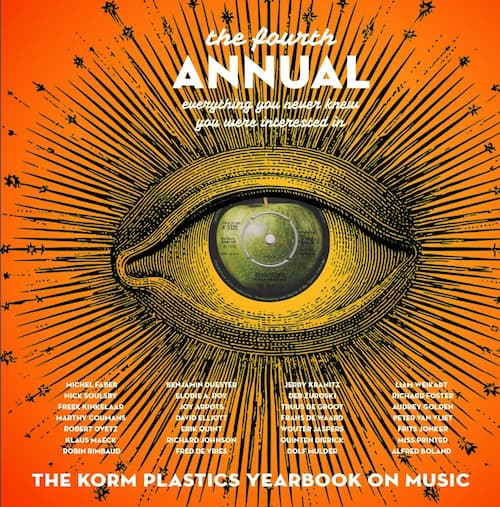
Source: The Fourth Annual, Kormplastics, p.193-203, 2026
Author: Dolf Mulder
POPOL VUH: THE UNITON – CICADA YEARS (1983-1988)
The music of the German group Popol Vuh, active from 1969 until the death of its leader, Florian Fricke, in 2001, was released on multiple record labels, which did not make the catalogue any easier to navigate. In the 1980s, these were primarily Uniton Records and Cicada Records. Both were small, Norwegian independent labels run by Tormod Opedal. Below is an account of this period, mainly drawing on the correspondence between Opedal and Fricke. This offers a fascinating insight into the life and times of a small record label, and into Fricke’s considerations regarding how he wished to present his music to the world.
AGAPE AGAPE LOVE LOVE (1983)
The LP Agape Agape Love Love, Popol Vuh’s 14th album, was surprising in several respects, first and foremost because of the return of guitarist Conny Veit. His last contribution had been in 1974, on the LP Seligpreisung. In that same year, he disbanded his own group, Gila, and joined Guru Guru for a short while. As far as I am aware, he had not been involved in any musical productions since then, until Fricke called on him again.[1]
Frank Fiedler, who has been part of Popol Vuh from the outset, particularly for his technical skills, is also making a comeback after many years’ absence. As a cameraman, he often worked abroad for extended periods, but he always remained in contact with Fricke as a friend and sparring partner.
Furthermore, the album was released on a new, small Norwegian independent label, an initiative by Tormod Opedal, which focuses on electronic music (Conrad Schnitzler, Tim Story), synth-pop (Fra Lippo Lippi) and post-punk experiments (Holy Toy), featuring musicians from both a younger and an older generation. This places Popol Vuh in somewhat different company, potentially bringing them to the attention of a different, younger audience.
Small independent labels were a dime a dozen during those years of New Wave and Neue Deutsche Welle. Still, they were generally not keen on releasing music by the older generation. Labels were on the lookout for a fresh, new sound. It was the era of Einstürzende Neubauten, Palais Schaumburg and Der Plan, to name but a few German examples. Innovative Communication, a record label founded by Klaus Schulze in 1978, which released Popol Vuh’s LP Sei Still, Wisse ICH BIN in 1981, also embraced the Neue Deutsche Welle movement with the band Ideal. In short, it was not always easy for bands that had emerged in the 1970s to remain under contract with a record label. Consequently, the opportunity offered by Opedal was very welcome to Fricke.
Tormod Opedal, a young music enthusiast, ran a music magazine in the early 1980s and imported records by, amongst others, Krautrock bands – records that were hard to come by in Norway. Subsequently, the plan to start his own record label began to take shape. The book Rock in Deutschland by Günter Ehnert[2], which Opedal had in his possession, contained many addresses of the bands featured in it. Opedal – who was in his early 20s at the time – simply decided to write to a number of these bands and musicians who interested him, asking whether they would be interested in releasing music on the label he was about to set up. He made contact with several musicians and established collaborations, including with Conrad Schnitzler and Hans-Joachim Roedelius. He also wrote to Florian Fricke. And to his great surprise, Fricke rang him a few weeks later and said he would be keen to release an album on Uniton Records. Fricke spoke broken English; Opedal, broken German—nevertheless, a good relationship developed between the two. Without signing a contract at that stage, Fricke sent over the music for Agape Agape Love Love.
The album was recorded between June and October 1982 at the Bavaria Musik Studio in Munich, where Popol Vuh had already recorded many albums. Alongside Fricke (piano, vocals, percussion), Conny Veit (guitar), Daniel Fichelscher (guitar, percussion), and Renate Knaup (vocals) also contributed. Frank Fiedler and a few others acted as ‘collaborators’. Stefano Massimo Jauch[3], who was involved in the recordings as an engineer, offers a glimpse into what went on during the sessions. “I worked at the Tonstudio in der Schornstraße (formerly Bavaria Musik Studios) as an engineer. Like Florian Fricke, the studio had chronic financial problems. The new head of the studio, Herbert Lehmler, was a lawyer and was originally the insolvency administrator of KS Global, which had leased the Bavaria Musik Studios from the well-known Bavaria Studio in Geiselgasteig, but whose boss had run into difficulties due to dubious business dealings. Herbert Lehmler fell in love with the studios (which consisted of two music studios, two dubbing studios and a mixing studio). For Florian and Popol Vuh it was a stroke of luck. Herbert Lehmler had a soft spot for artists. Empty studios broke his heart. So he had Popol Vuh record there. With Florian, you never knew how long the recordings would take and how big they would actually be. So, it was always a bit risky to leave him a studio. It was summer, holiday time; the studio wasn't exactly fully booked, and I was a young engineer prepared to tolerate the erratic start and end times of the sessions. I remember Popol Vuh as consisting only of Florian and Danny Fichelscher, two not always easy characters who liked to argue over artistic details. Florian liked the warm wooden sound of the big room in Studio A. His recording style was fundamentally different from that of other artists and bands. He usually played a composition on the piano in an endless loop, signalled to me at some point when he liked the flow and the spirit, and only then did I start recording. That was a challenge, especially with meditative tracks. I couldn't drift off, couldn't miss the moment that Florian called the descent. As always, hash was involved. I didn't care about that. In those days, that wasn't unusual, but, of course, it affected the process in the studio, making everything slower. It sometimes almost stopped time, and I think that's what fascinated Florian about it. Sometimes he and Danny would discuss things for half an hour, trying things out, which sometimes turned out well and sometimes was rubbish: trial and error. Danny wanted to hang a big drum from the studio roof and, at a certain point in the track, run up to it, jump, and hit it with his hand. Amplifiers were set up here and there to achieve different sounds. Other musicians thought about their budget, about the trouble they would get into with the record company if they overdid it. Florian managed to ignore that completely. He was only interested in the art, in the fluidity that should shine from his compositions. That was the most important, most urgent thing on every recording day, to which he subordinated everything and everyone. Hidden somewhere in his amiable lack of planning was a master plan. With a lot of patience, he tried to lure the rabbits out of their burrows, and then, when nobody expected it, they came out.”[4]
Fricke was responsible for all the compositions, except one track, They Danced, They Laughed, As Of Old, which is credited to Daniel Fichelscher. Listeners familiar with Fricke’s work will recognise recurring themes and motifs from his earlier compositions. This is because, for Fricke, they are time and again the means by which he achieves the expressiveness and depth he seeks as a composer.
Musically, the album featured a diverse range of pieces. It opened with Hand in Hand, which features choral-led chanting. The pulsating, guitar-driven They Danced, They Laughed, As Of Old is a superb raga-rock track. The swirling track Agape, Agape centres around an uplifting melody with trance-inducing chanting. Life, Love, Death is an almost ritualistic, percussion-dominated piece that reflects influences from Eastern music. The Christ is Near was of almost bombastic proportions, thanks to Fichelscher’s percussion and guitar, and is dominated by the ‘Yehung’ chanting.
The album is not only musically diverse but also a coherent whole, united by the characteristic spiritual atmosphere Fricke evoked in his music, which defined the sound from start to finish.The titles of the pieces refer to various religious themes and give an impression of what inspired Fricke at that time. Gerhard Augustin, who was involved with Popol Vuh for many years as a producer, suggested in conversation with Fricke that he chose religious titles because this had simply become part of Popol Vuh’s image and appealed to a certain audience.[5] It seems far more plausible to me that religious and spiritual themes held a personal interest for Fricke throughout his life, and that this interest shaped him both as a person and as a composer. He had no interest whatsoever in missionary zeal. For him, music was, as it were, a form of prayer or a healing force, as Fricke himself repeatedly remarked.[6]
For the album title, Fricke draws on a key concept from the Christian tradition: ‘agape’, a Greek word meaning ‘love’. In the New Testament, it denotes a specific form of love, distinct from ‘eros’, passionate love, and ‘philia’, the love of friendship. Agape, or love for one’s neighbour, is the highest form of love that extends to both friend and foe: the love of God and love for God; selfless love for one’s neighbour; love for God and God’s love for humankind. Agape chooses to regard the other person as described in 1 Corinthians 13: always ready to think the best of the other, ready to forgive, and willing to seek the best for the other.
Fricke seeks to express this not through a philosophical or theological argument, nor through poetry, but through music. Fricke: “It is the noble task of music to unite heaven and earth. In burning with passion, in devotion, you find the path to the heart of the living force, to the great love that desires nothing and knows nothing of itself. Then your song rises into the spheres of eternal song, and you sing hand in hand with the angels.”[7]
The title The Christ is Near undoubtedly refers to the work of Benjamin Creme, an English artist and esotericist who proclaimed the second coming of Christ. He claimed to be in telepathic contact with Christ, who, since 1977, was said to be residing somewhere in the modern West and would soon reveal himself to the world. This is no small claim. Benjamin Creme made this known to the world after he came into telepathic contact with the “Hierarchy of the Masters of Wisdom”. “These Masters, whose existence was first brought to public attention in our time by Madame Helena P. Blavatsky, the founder of the Theosophical Society, are not gods. They are human beings like you and me, and the term ‘Master’ is to be understood as meaning that they have perfected themselves over a long series of different lives, until they reached a point in their evolution where further incarnation on Earth was no longer necessary. [..] At the head of this great spiritual brotherhood stands the World Teacher, the Master of Masters. It is not always the same person. For 2,600 years, this position has been held by ‘Maitreya’, as is His own name,”[8] said Creme in an interview with Fricke that appeared in the German New Age magazine Esotera. At the end of the interview, Fricke objects: “Is it not written that the Christ will return like a thief in the night? How does that fit in with your claim that he will return in 1982 – as you have publicly announced?” Creme: “The answer is that He is not coming in 1982, but that, completely unexpectedly for everyone, He has already resumed His place in the world since 1977. However, I am not authorised to reveal His current whereabouts. This is because He does not wish to impose anything on humanity. Recognising the Christ must come from the heart, through accepting His proposals for building a better society’.”[9] So, the Christ is near, but whether this becomes a reality depends on us…
The interview announced a lecture that Creme was due to give in Munich on 4 March 1982. Bettina von Waldthausen – Florian’s partner – was involved in organising this event. She had been familiar with Benjamin Creme and his mission for some time and had worked hard to bring him to Germany. She remained involved with Creme and his mission for many years. Whenever Benjamin Creme came to Germany, he always stayed with Bettina. Fricke and Creme got on well as artists. However, Fricke maintained a certain distance from Creme’s ideas as an esotericist. Nor does the interview reveal what Fricke himself thought of these theories. Fricke confined himself to practical matters, but there does seem to have been a certain receptiveness to these theories, according to Andrea Bistrich, a friend of Bettina’s who was also involved in the movement surrounding Creme for many years. Fricke remained reserved but interested. Florian was an independent person who wanted to discover and create for himself, and did not simply accept things or commit to anything without careful consideration.[10]
The theosophical concept of a hierarchy of masters also forms the basis of the so-called texts of Master Morya, recorded by the theosophist and writer Helena Roerich, which Fricke had previously drawn upon (LP Die Nacht der Seele). Apparently, he was able to make sense of this literature and these theories.[11]
Two other titles refer to the 13th-century Persian poet and mystic Rumi: Behold, the drover summons and Why do I sleep?[12] The poet Rumi is known for his universalist and inclusive approach to spirituality, a viewpoint that Fricke shared. Rumi: “What is praised is one, so the praise is one too, many jugs being poured into a huge basin: all religions, all this singing, one song. The differences are just illusion and vanity. Sunlight looks a little different on this wall than it does on that wall and a lot different on this other one, but it is still the same light.”[13]
Why Do I Still Sleep, the longest track, is a minimalist ballad, a solo piece by Fricke on piano with sparse guitar accompaniment by Fichelscher. Simplicity is the way. According to Fiedler, it was not the best recording, having been made with a simple ghetto blaster. Although recordings were made with much better sound quality, Fricke preferred this one because this performance achieved a certain meditative depth.[14] Strangely enough, the poor quality adds to the music's atmosphere. It’s as if the music reaches you from an undefined, otherworldly realm.
When asked what he considers to be the highlights of his musical career, he mentions the albums Hosianna Mantra and Agape Agape Love Love, whilst emphasising the track Why do I still sleep. When asked what was so special about it, Fricke replies: “There was something special in this instance, both during the recording and whilst playing. Of course, there have been moments during my musical career that have made me very happy. But it’s not so much the external things that are as exciting as when musicians can play together, no matter what style. And that’s the most important thing in a musician’s life.”[15]
Can the music press come to terms with this music, which pays no heed to the latest musical trends and is brimming with religious and esoteric references? I have been unable to find any reviews in the German music press of that time. Writing for the English magazine Sounds, Sandy Robertson says: “Kenneth Grant wrote a book called Outside the Circles of Time. Popol Vuh are a little like that: beyond the vagaries involved in the usual machineries of joy (?) that hold sway and dominance in the music business, Florian Fricke makes albums in Munich that avoid the crude fits and starts that pass muster as ‘progressions’ in rock. Apart from his early experiments with Moog synthesisers, his records could be shuffled and arranged in any order, rather like a Tarot deck. As intangible as dreams and spirits, they evoke traces of long-dead cultures and timeless gods. […] The titles are the usual gently informative yet vaguely pantheistic symbols of ecstasy – They danced, they laughed, as of old; The Christ is near; Behold, the drover summons; Why do I still sleep… Why indeed? There’s still time to experience vinyl transubstantiation.”[16]
Swie Tio, writing for Muziekkrant OOR, the largest music magazine in the Netherlands at the time, described the album in a single word as ‘sublime’, calling it an album that eclipses Popol Vuh’s previous work. Tio is surprised that the “die-hard hippies” of Popol Vuh manage to make an impression amidst the “Kowalskis and Nenas” of that era.[17]
In an information sheet, Uniton Records describes Popol Vuh as “one of the leading proponents of New Age music.”[18] Alongside Uniton Records, the album was also released for the German market on cassette by Hermann Bauer Verlag KG, a publisher of books and music in the fields of music and esotericism located in Freiburg im Breisgau. New Age and New Age music were all the rage, and it was only natural that Popol Vuh would be associated with them. We’ll come back to this shortly when discussing Spirit of Peace.
Uniton Records released more than 30 records[19], including the compilation LP Burning the Midnight Sun, on which the title track Agape features alongside tracks by Eyeless in Gaza and various Norwegian synth-pop acts. Although Uniton Records ceased operations in 1985, Opedal launched a new label – Cicada Records – at the same time and brought Popol Vuh with him to it.
SPIRIT OF PEACE (1985)
For the sake of chronology, we should now turn our attention to Florian Fricke’s LP Die Erde und Ich sind Eins (1983). This album was a recording of a breath-therapy session, intended by Fricke for use by therapists. It offers an insight into the breath therapy that Fricke developed, which was practised primarily in group settings. Although a few musical elements have been added, it was not released as a Popol Vuh album. The true successor to Agape Agape Love Love is LP Spirit of Peace, which appeared in 1985 as the first release on Cicada Records, a label that billed itself as a ‘New Music’ label. With composers and musicians such as Erik Wøllo, Hans-Joachim Roedelius, Tim Story and Ketil Bjørnstad, Cicada Records would go on to develop a more distinct profile than Uniton Records.
Fricke urges Opedal to release the LP on cassette as well, “as many of our listeners only own a cassette recorder.”[20] And this does indeed happen, albeit not until 1988. However, like its predecessor, the album was released simultaneously on cassette by the German publisher Hermann Bauer Verlag KG. As on Agape Agape Love Love, the track titles are once again entirely in English, reflecting a focus on the international market.
The planned re-release of Agape Agape Love Love on Cicada Records did not materialise.[21] However, Cicada Records did release the compilation CD Gesang der Gesänge, featuring a selection of Popol Vuh tracks from the 1970s. It is one of the few compilations curated by Fricke himself.
The letter quoted above offers a rare insight into Fricke’s involvement in the cover design. In the past, this was usually in the hands of the record labels, and Fricke had little influence over it.[22] Fricke: “I envisage the background colour of the cover as pink, like the colour of an old rose petal”, and suggests possibly using a photograph of such a rose for this purpose.[23] A photograph of the band was to be featured in the background, but on 9 September 1985, Fricke wrote that the photograph was horrible and suggested releasing the LP without a photograph instead. Ultimately, no photographs appeared on the original release of this LP; instead, it was a solid shade of pink. When Fricke discussed the planned CD reissue on Cicada Records in 1987 – which never materialised – he suggested making the front cover more attractive by using a photograph from his film Sei Still, wisse ICH BIN of the prophet near the water, which had already graced the cassette release on Hermann Bauer Verlag KG and would go on to feature centrally on the front cover of all subsequent reissues.
According to the sleeve notes, the opening track We know about the need was recorded for Werner Herzog’s film Gasherbrum – Der leuchtende Berg (The Dark Glow of the Mountains). This documentary, which premiered on 3 April 1985, follows mountaineers Reinhold Messner and Hans Kammerlander during their ascent of Gasherbrum I and II. In the Werner Herzog Archive, housed at the Deutsche Kinemathek in Berlin, I found only two contracts between Fricke and Werner Herzog Filmproduktion. One was for Aguirre, der Zorn Gottes, the other for Gasherbrum – der leuchtende Berg, signed on 19 October 1984.
What music did Fricke compose for this documentary? GEMA (Society for Musical Performing and Mechanical Reproduction Rights) lists one composition, namely Gasherbrum – der leuchtende Berg (Musik für 8000 Meter), with a duration of 8:50. This is almost double the track's length on the LP. In addition, a number of existing tracks by Popol Vuh were used for this documentary, namely: Andacht, …als lebten die Engel auf Erden and Singt, denn der Gesang vertreibt die Wölfe.
We know about the need contains one of the most impressive versions of the Yehung chant, which Florian Fricke incorporated into various compositions[24]. This chant originated from his work in breath therapy and has been integrated into his music, which initially featured adapted texts from the Bible (Seligpreisung, Das Hohelied Salomos), but over time chanting has come to play an increasingly important role.
When asked by Renate Knaup what she is feeling when she sings the Yehung chant, she replies: “It’s just an inner current that carries me along. Through the melodic line and the intensity of the composition, the melody itself—and then the singing, the sound and the feeling all become one, and that carries you. It’s warm, too. It’s simply warm. And I don’t want to say this now, but there’s definitely something divine about it, something… up there somewhere. [ …] You transcend certain boundaries. Simply stoned. Ecstatic. That’s quite a lovely word; it fits very well.”[25]
We are familiar with the track Song of the Earth, taken from Die Erde und Ich sind Eins and recorded and released in 1983. Side Two features a long composition, Take the Tension High – a single, extended track similar to those found on the LPs Brüder des Schattens and Söhne des Lichts, but not present on later work. The piece opens with chanting by Renate Knaup and Fricke before guitars build a multi-tracked tapestry of recurring patterns, played by Danny Fichelscher, Conny Veit and Bernd Wippich. The latter, known for his work with the Petards and Randy Pie, makes a one-off appearance here as a guest musician. On the cassette release by Hermann Bauer Verlag KG, this track is titled "Die Hochzeit zu Kanaa" and refers to the New Testament miracle story in which Jesus turns water into wine at a wedding.
According to the sleeve notes, the music was recorded at the so-called Quadrat Studio in Munich. This studio does not appear elsewhere in the Discogs database, raising the question of exactly what sort of place it was. The recording period is given as March–June 1985. Given that Gasherbrum premiered in early April, it seems unlikely that We Know about the need was recorded during this period. We can say this with certainty about Song of the Earth, taken from Die Erde und ich sind Eins (1983). The same applies to the track Spirit of Peace. There is a different story behind this last composition, and Eckart Rahn (Celestial Harmonies) should be mentioned here.
THE SPIRIT OF PEACE PIANO RECORDINGS
In the early 1970s, Rahn founded the Kuckuck label in Munich, which for many years provided a home for Deuter, Peter Michael Hamel, Out of Focus and many others. Around 1980, when the label was renamed Celestial Harmonies, a collaboration between Rahn and Fricke came about. In the summer of that year, “the three parts of Spirit of Peace were recorded at the concert hall of the music academy in Munich. Ulrich Kraus [DM: sound engineer] was then working full-time at the academy. A Hamburg Steinway D was used. Incidentally, it was Celestial Harmonies’ first digital recording. Ulrich Kraus switched back and forth between the original audio from the stage and the recording. I couldn’t detect any difference,”[26] said Rahn. Elsewhere on the Celestial Harmonies website, 1981 is cited as the year of recording. We were at the dawn of the CD era.[27]
This took place whilst Fricke was working on the project Sei still, wisse ICH BIN, which was recorded in 1980 and released in 1981 on Klaus Schulze’s label Innovative Communication. I have not been able to ascertain how the collaboration with Rahn came about or what the intention behind the recordings was[28]. In any case, a contract was drawn up between Fricke and Celestial Harmonies in the early 1980s. Rahn: “The legal situation was, shall we say, unclear. But Florian Fricke wasn’t interested in that. He just wanted the contract signed quickly so he could get his cheque with the advance payment.”[29] Rahn says nothing about his own role in the content of this agreement.
In 1980, Rahn settled in the United States, intending to establish a distribution channel for Kuckuck Records through Celestial Harmonies. However, it soon became a label in its own right, and through this channel, Popol Vuh’s records were first released in the United States.[30] The collaboration with this label brought with it associations with New Age music, which was all the rage at the time and with which Celestial Harmonies identified. First came a (re-)release in 1981 of the albums Hosianna Mantra and Tantric Songs, hailed by Celestial Harmonies as “classics in the field of contemplative music.”[31] With these releases, Popol Vuh became available on the American market for the first time. At first glance, Tantric Songs appears to be a standalone new album by Popol Vuh, but it is, in fact, a compilation that brings together the track Brüder des Schattens, Söhne des Lichts from the album of the same name with various tracks from Die Nacht der Seele. However, this is not mentioned on the sleeve. The subtitle of Die Nacht der Seele, namely Tantric Songs, is now promoted to the title. Rahn himself is responsible for translating the titles from German into English: “I am also responsible for the rendering of the German titles in English. Andacht and Devotion do not quite have the same meaning. It was a complicated effort to translate Florian Fricke’s titles into English. Some words turned out to be untranslatable. You try to get as close to the meanings as possible.”[32]
It would then be another couple of years before Rahn released the Spirit of Peace tracks. In 1983, the double LP In The Gardens Of Pharao/Aguirre was released. At first glance, this appears to be a reissue of two early Popol Vuh LPs. However, this is only the case for the LP In den Garten Pharaos (1971). From the LP Aguirre (1976), only Aguirre 1 appears on this reissue, in a digital remix. This marks the first time the phenomenon of the remix has appeared in connection with a Popol Vuh release. Many more were to follow.
Furthermore, one side of the record is filled with the three Spirit of Peace solo piano pieces. They have been added to the older material without any explanation, resulting once again in a confusing release. Spirit of Peace I and Spirit of Peace II later reappear on the CD Keys of Life – Piano Music from Celestial Harmonies (1986), which also features piano music by Peter Michael Hamel, Hans Otto. Years later, the piano suite appeared on reissues of Aguirre by Spalax Music (1992 and 1996) and ZYX Music (1999), where it was listed as ‘previously unreleased’. It was only when Edition Popol Vuh (Johannes Fricke Waldthausen) gained access to the tracks that they were given a more appropriate context. On the double CD + DVD set Kailash (2015), they are brought together with other solo piano pieces by Fricke from various periods of his career. They are also included on the reissue of Spirit of Peace (One Way Static, 2017).
In a letter dated 9 August 1987, Fricke writes to Opedal that he has not worked with Rahn for three years because Rahn never pays. So, while Fricke had been doing business with Opedal to his satisfaction over the years, the opposite had been true of Rahn. How does Rahn look back on Fricke as a person and on Popol Vuh? “He was one of the most tragic, but also one of the most interesting characters I ever had the privilege of meeting. At 40, he looked like he was 80. Drugs destroyed him. Popol Vuh had far more musical substance than a band like Amon Düül, who were also active in Munich at the time. Fricke’s music was incredibly original, but in places, it was recorded with sensationally sloppy production. He always wanted to ensure there was something left over from the production budget.”[33]
Let’s return to Spirit of Peace. On the cover of the cassette edition of Geist des Friedens published by Hermann Bauer Verlag KG, the following quote from Fricke is featured: “I had a vision of the music of the age to come. This is music that was, as it were, born of itself; music you do not have to listen to and yet, you hear it; music that touches the inner self and brings what is eternally valuable within it into the present. It changes your perception – a new space emerges, an inner smile, a still lake. Music that comes from an inner home, which belongs to no one and is shared by all – music that opens hearts.”[34] Inspired by these ideas, the LP offers a collection of pieces created over recent years.
Has the music press noticed the album? Hardly. Not in the mainstream press covering popular music, let alone in music magazines specialising in serious, contemporary music. Perhaps to some extent in media focusing on New Age (Music), but I haven’t looked into that. New Age music had its precursors in the counterculture of the 1960s and 1970s (Tony Scott, Paul Horn), before expanding in the 1980s and 1990s into a form of mainstream relaxation music that soon acquired a negative image. Gary Lucas (former Captain Beefheart guitarist), who would go on to interpret a few Popol Vuh tracks in his solo work, refers to Spirit of Peace in his obituary on Fricke: “Florian Fricke was definitely hotwired to the cosmos – it’s delicate and dreamy without succumbing to any namby-pamby Windham Hill horseshit. The real New Age starts here.”[35]
GESANG DER GESANGE
Following the release of Spirit of Peace, Opedal and Fricke discussed the possibility of re-releasing several albums from the Popol Vuh catalogue on CD via Cicada Records. But things turned out differently. Changes in his personal circumstances forced Opedal to take on other work, and he subsequently disappeared from the music business for some years. Meanwhile, Milan Records came onto the scene for Fricke, an American-founded label specialising in soundtracks and offering far greater distribution opportunities. Nevertheless, one more release appeared on Cicada. “After recording Cobra Verde (Milan, the soundtrack to Werner Herzog’s new film), Florian Fricke spent some time at the Munich Union Studio to remix, edit and compile the material for Gesang der Gesänge, an exclusive CD for Cicada.”[36]
Correspondence between Opedal and Fricke reveals that Fricke had his own preferences regarding which tracks to include on the compilation, but he invited Opedal to add his own suggestions. “I’m really pleased about the Best of LP. Nicht hoch im Himmel from the LP Hosianna Mantra definitely has to be on it. Likewise, some tracks from Sei still, wisse ICH BIN, Brüder des Schattens – Söhne des Lichts, Herz aus Glas, and Singet denn der Gesang vertreibt die Wölfe. If you’re no longer distributing Agape Agape, we should also include something from that LP. Please write to me with your suggestions; I’ll then go into a studio and compile the tracks.”[37] It is impossible to trace exactly how the collection came about. Ultimately, it became a selection of pieces from the years 1971–1974. The parallel cassette release on Hermann Bauer Verlag KG describes the selection as a ‘song cycle based on mystical texts from the Old Testament (Book of Deuteronomy, Song of Solomon)’.
The CD opens with the well-known theme from Aguirre, which we usually know as Aguirre I. It is striking – though perhaps not entirely surprising – that Fricke opts for the original title, as he himself had conceived it: Lacrime di Re[38], referring to a scene in the film. The final section of In den Garten Pharaos, in which Fricke plays the Fender Rhodes in an almost jazzy style, is included here as a separate track titled Schilfmeer, taken from the Old Testament book of Exodus and likely referring to a part of the Red Sea. The title of the CD is in German this time, Gesang der Gesänge, referring to the biblical Book of Song of Songs, also known in German as Hohelied Salomos.
In a letter dated 6 July 1987, Fricke writes to Opedal: “In the coming weeks we will begin production on a new LP with the working title Hab’mut, bis dir die Sonne wieder scheint; some of it is intended to be the soundtrack for Werner Herzog’s latest film, Cobra Verde”, and offers to release this record through Opedal. In a subsequent letter[39], he refers to this LP as Gesang der Engel, and it is announced under that name in the September 1987 newsletter of Cicada Records: “Florian Fricke & Co. are now recording a brand-new album entitled Gesang der Engel. This time with a classically trained vocalist and a Fairlight synth to create the magical choir. Werner Herzog will use part of the album in his new film Cobra Verde. This title and others will be released on CD by Cicada.” However, in the first Cicada newsletter of 1988, we read that the situation had changed: Der Gesang der Engel, which was scheduled for release on Cicada, has been postponed and will most likely be released under a new title. What happened was that Popol Vuh became so involved with Herzog’s soundtrack music that they recorded a soundtrack album for Milan instead of a new studio album.” And so it came to pass. Once again, a project Fricke was working on is intertwined with Herzog’s request for music for his new film. The final result, therefore, probably includes the music he had in mind for Gesang der Engel.
In 1989, Fricke discussed a second Best of album with Opedal, combining music from Cobra Verde with “my favourite track from Herz aus Glas and the Spirit of Peace suite.”[40] They also discussed the re-release of various Popol Vuh albums on CD via Cicada. However, these plans never came to fruition. For instance, Opedal was in talks with Marty Scott of the American label Jem Records to release the Cicada Records catalogue in the US, including Popol Vuh. However, Jem Records went bankrupt. Personal circumstances forced Opedal to end his work in the music industry, meaning that Cicada Records was destined for a short life.
Looking back, Opedal is proud to have been able to release two classic Popol Vuh albums, with sales of around 4,000 copies of Agape Agape Love Love, 3,000 of Spirit of Peace, and 1,000 of Gesang der Gesänge. Popol Vuh were now set to enter into a long-term partnership with Milan Records, a much larger player with greater international distribution capabilities. When Bettina von Waldthausen told me many years later[41] about the numerous problems Florian had encountered with various record labels, she emphasised that there had never been any issues with Opedal. This collaboration went very well. Fricke and Opedal never met.
Agape, Agape Love Love and Spirit of Peace are compelling examples of Fricke’s intention and ability to create a universalist spiritual music that comes into its own apart from any liturgical or ritual context. Which, of course, is only possible—as we’ve seen here—through the involvement of musicians, studios, producers, record labels, distribution channels, Werner Herzog, and the media, with all the positive and negative aspects that this entails. Songs of the Earth, isn’t that right?
Dolf Mulder
www.popolvuh.nl
[1] In 1985-1986 he would release two more 12-inches featuring poppy new wave music with his group Coney Island.
[2] G.Ehnert, Rock in Deutschland – Lexikon deutscher Rockgruppen und Interpreten, Taurus, Hamburg, 1979.
[3] Later, he would develop into a prolific film composer, particularly for German TV productions.
[4] From email correspondence, 2025.
[5] Popol Vuh im Interview with Gerhard Augustin, on: Youtube. Retrieved on August 11, 2026.
[6] R.Langhans, Musik ist für mich eine Form des Gebets, in: Sounds, nr.49, 1973, p.35-37.
[7] From liner notes on Agape Agape Love Love, Hermann Bauer Verlag KG: “Es ist die hohe Aufgabe der Musik, Himmel und Erde zu vereinen. Im Entbrennen, in de Hingabe findest du den Weg zum Herzen der lebendigen Kraft, zur grossen Liebe, die nichts will und nichts von sich weiss. Dann erhebt sich dein Gesang in die Sphären des ewigen Gesangs und du singst mit den Engeln Hand in Hand.”
[8] F.Fricke, Ein Prophet der Hoffnung, in: Esotera, nr.2, 1982, Hermann Bauer Verlag KG, p.163-164. My translation.
[9] Idem, p.169. My translation.
[10] From correspondence with Andrea Bistrich, june 2025.
[11] Blätter des Gartens Morya, Spirale Verlag, Linz, 1964.
[12] A.Luviano-Cordero, Popol Vuh, in: Offbeat, december 1993 – january 1994, p.16-17.
[13] Rumi, One Song (poem). Retrieved here (august 2026): https://scienceandnonduality.com/article/one-song/.
[14] From interview with Frank Fiedler, 2023.
[15] Offbeat, p.17.
[16] S.Robertson, Agape Agape Love Love, in: Sounds, 1983.
[17] S.Tio, Agape Agape Love Love, in: Muziekkrant OOR, 1983.
[18] A Popol Vuh Biography (infosheet), Uniton Records, 1983.
[19] For catalogue Uniton Records: https://nxp-label.blogspot.com/2004/09/uniton-records.html (retrieved august 2026).
[20] Letter of Fricke to Opedal, june 30, 1985. My translation.
[21] Spirit of Peace, infosheet, Cicada Records.
[22] Popol Vuh im Interview with Gerhard Augustin, on: Youtube. Retrieved on August 11, 2026.
[23] Letter of Fricke to Opedal, june 30, 1985. My translation.
[24] Earliest examples: In der Halle des Lernens from Die Nacht der Seele (1979); Wehe Khorazin from Sie still, wisse ICH BIN (1981)
[25] From interview with Renate Knaup, 2011. My translation.
[26] From correspondence, 2022.
[27] See: https://www.harmonies.com (retrieved august 11, 2026).
[28] Rahn has no recollection of this (correspondence 2022).
[29] F.Peltsch, Mein ganzes Leben ist Casino, in: Mint, 11, 2021, p.52. My translation.
[30] See: https://www.harmonies.com (retrieved august 11, 2026).
[31] See: https://www.harmonies.com (retrieved august 11, 2026).
[32] From correspondence, 2022
[33] Mint, p.53. My translation.
[34] From liner notes on Spirit of Peace, Hermann Bauer Verlag KG: “Ich hatte die Vision von einer Musik der kommenden Zeit. Dies ist die Musik, die gleichsam aus sich selbst geboren wurde, der du nicht zuhören musst und sie dennoch hörst, die den inneren Menschen berührt und das ewig Wertvolle in ihm in die Gegenwart bringt. Sie verändert deine Wahrnehmung – ein neuer Raum entsteht, ein inneres Lächeln, ein stiller See. Eine Musik, die aus einer inneren Heimat kommt, die niemanden gehört und allen gemein ist – Musik die Herze öffnet.”
[35] G.Lucas. Epiphanies, in: Wire, nr.216, 2002, p.98.
[36] Cicada Newsletter, 1, 1988.
[37] Letter of Fricke to Opedal, juli 6,1987. My translation.
[38] This title is cited as the collective title in the contract between Fricke and Werner Herzog Produktion for the compositions Fricke is to provide for the film Aguirre, the Wrath of God. Deutsche Kinemathek, Berlin.
[39] Letter of Fricke to Opedal, august 9, 1987.
[40] Letter of Fricke to Opedal, september 14, 1989. My translation.
[41] During my first meeting with Bettina von Waldthausen in 2008.
!-- {"type":"layout","children":[{"type":"section","props":{"image_position":"center-center","style":"default","title_breakpoint":"xl","title_position":"top-left","title_rotation":"left","vertical_align":"","width":"default"},"children":[{"type":"row","children":[{"type":"column","props":{"image_position":"center-center","position_sticky_breakpoint":"m"},"children":[{"type":"headline","props":{"content":"
Source: The Fourth Annual, Kormplastics, p.193-203, 2026
Author: Dolf Mulder
","image_align":"left","image_margin":"xsmall","title_element":"h5"}},{"type":"headline","props":{"content":"
POPOL VUH: THE UNITON – CICADA YEARS (1983-1988)
","image_align":"left","image_margin":"xsmall","margin_top":"remove","title_element":"h1"}}]}]},{"type":"row","props":{"layout":"1-2,1-2"},"children":[{"type":"column","props":{"image_position":"center-center","position_sticky_breakpoint":"m","width_medium":"1-2"},"children":[{"type":"image","props":{"image":"images/Archive/The Fourth Annual.jpg","image_svg_color":"emphasis","margin_bottom":"default","margin_top":"default"}}]},{"type":"column","props":{"image_position":"center-center","position_sticky_breakpoint":"m","width_medium":"1-2"}}]},{"type":"row","children":[{"type":"column","props":{"image_position":"center-center","position_sticky_breakpoint":"m"},"children":[{"type":"text","props":{"column_breakpoint":"m","content":"
The music of the German group Popol Vuh, active from 1969 until the death of its leader, Florian Fricke, in 2001, was released on multiple record labels, which did not make the catalogue any easier to navigate. In the 1980s, these were primarily Uniton Records and Cicada Records. Both were small, Norwegian independent labels run by Tormod Opedal. Below is an account of this period, mainly drawing on the correspondence between Opedal and Fricke. This offers a fascinating insight into the life and times of a small record label, and into Fricke’s considerations regarding how he wished to present his music to the world.
\n
AGAPE AGAPE LOVE LOVE (1983)
\n
The LP Agape Agape Love Love, Popol Vuh’s 14th album, was surprising in several respects, first and foremost because of the return of guitarist Conny Veit. His last contribution had been in 1974, on the LP Seligpreisung. In that same year, he disbanded his own group, Gila, and joined Guru Guru for a short while. As far as I am aware, he had not been involved in any musical productions since then, until Fricke called on him again.[1]
\n
Frank Fiedler, who has been part of Popol Vuh from the outset, particularly for his technical skills, is also making a comeback after many years’ absence. As a cameraman, he often worked abroad for extended periods, but he always remained in contact with Fricke as a friend and sparring partner.
\n
Furthermore, the album was released on a new, small Norwegian independent label, an initiative by Tormod Opedal, which focuses on electronic music (Conrad Schnitzler, Tim Story), synth-pop (Fra Lippo Lippi) and post-punk experiments (Holy Toy), featuring musicians from both a younger and an older generation. This places Popol Vuh in somewhat different company, potentially bringing them to the attention of a different, younger audience.
\n
Small independent labels were a dime a dozen during those years of New Wave and Neue Deutsche Welle. Still, they were generally not keen on releasing music by the older generation. Labels were on the lookout for a fresh, new sound. It was the era of Einstürzende Neubauten, Palais Schaumburg and Der Plan, to name but a few German examples. Innovative Communication, a record label founded by Klaus Schulze in 1978, which released Popol Vuh’s LP Sei Still, Wisse ICH BIN in 1981, also embraced the Neue Deutsche Welle movement with the band Ideal. In short, it was not always easy for bands that had emerged in the 1970s to remain under contract with a record label. Consequently, the opportunity offered by Opedal was very welcome to Fricke.
\n
Tormod Opedal, a young music enthusiast, ran a music magazine in the early 1980s and imported records by, amongst others, Krautrock bands – records that were hard to come by in Norway. Subsequently, the plan to start his own record label began to take shape. The book Rock in Deutschland by Günter Ehnert[2], which Opedal had in his possession, contained many addresses of the bands featured in it. Opedal – who was in his early 20s at the time – simply decided to write to a number of these bands and musicians who interested him, asking whether they would be interested in releasing music on the label he was about to set up. He made contact with several musicians and established collaborations, including with Conrad Schnitzler and Hans-Joachim Roedelius. He also wrote to Florian Fricke. And to his great surprise, Fricke rang him a few weeks later and said he would be keen to release an album on Uniton Records. Fricke spoke broken English; Opedal, broken German—nevertheless, a good relationship developed between the two. Without signing a contract at that stage, Fricke sent over the music for Agape Agape Love Love.
\n
The album was recorded between June and October 1982 at the Bavaria Musik Studio in Munich, where Popol Vuh had already recorded many albums. Alongside Fricke (piano, vocals, percussion), Conny Veit (guitar), Daniel Fichelscher (guitar, percussion), and Renate Knaup (vocals) also contributed. Frank Fiedler and a few others acted as ‘collaborators’. Stefano Massimo Jauch[3], who was involved in the recordings as an engineer, offers a glimpse into what went on during the sessions. “I worked at the Tonstudio in der Schornstraße (formerly Bavaria Musik Studios) as an engineer. Like Florian Fricke, the studio had chronic financial problems. The new head of the studio, Herbert Lehmler, was a lawyer and was originally the insolvency administrator of KS Global, which had leased the Bavaria Musik Studios from the well-known Bavaria Studio in Geiselgasteig, but whose boss had run into difficulties due to dubious business dealings. Herbert Lehmler fell in love with the studios (which consisted of two music studios, two dubbing studios and a mixing studio). For Florian and Popol Vuh it was a stroke of luck. Herbert Lehmler had a soft spot for artists. Empty studios broke his heart. So he had Popol Vuh record there. With Florian, you never knew how long the recordings would take and how big they would actually be. So, it was always a bit risky to leave him a studio. It was summer, holiday time; the studio wasn't exactly fully booked, and I was a young engineer prepared to tolerate the erratic start and end times of the sessions. I remember Popol Vuh as consisting only of Florian and Danny Fichelscher, two not always easy characters who liked to argue over artistic details. Florian liked the warm wooden sound of the big room in Studio A. His recording style was fundamentally different from that of other artists and bands. He usually played a composition on the piano in an endless loop, signalled to me at some point when he liked the flow and the spirit, and only then did I start recording. That was a challenge, especially with meditative tracks. I couldn't drift off, couldn't miss the moment that Florian called the descent. As always, hash was involved. I didn't care about that. In those days, that wasn't unusual, but, of course, it affected the process in the studio, making everything slower. It sometimes almost stopped time, and I think that's what fascinated Florian about it. Sometimes he and Danny would discuss things for half an hour, trying things out, which sometimes turned out well and sometimes was rubbish: trial and error. Danny wanted to hang a big drum from the studio roof and, at a certain point in the track, run up to it, jump, and hit it with his hand. Amplifiers were set up here and there to achieve different sounds. Other musicians thought about their budget, about the trouble they would get into with the record company if they overdid it. Florian managed to ignore that completely. He was only interested in the art, in the fluidity that should shine from his compositions. That was the most important, most urgent thing on every recording day, to which he subordinated everything and everyone. Hidden somewhere in his amiable lack of planning was a master plan. With a lot of patience, he tried to lure the rabbits out of their burrows, and then, when nobody expected it, they came out.”[4]
\n
Fricke was responsible for all the compositions, except one track, They Danced, They Laughed, As Of Old, which is credited to Daniel Fichelscher. Listeners familiar with Fricke’s work will recognise recurring themes and motifs from his earlier compositions. This is because, for Fricke, they are time and again the means by which he achieves the expressiveness and depth he seeks as a composer.
\n
Musically, the album featured a diverse range of pieces. It opened with Hand in Hand, which features choral-led chanting. The pulsating, guitar-driven They Danced, They Laughed, As Of Old is a superb raga-rock track. The swirling track Agape, Agape centres around an uplifting melody with trance-inducing chanting. Life, Love, Death is an almost ritualistic, percussion-dominated piece that reflects influences from Eastern music. The Christ is Near was of almost bombastic proportions, thanks to Fichelscher’s percussion and guitar, and is dominated by the ‘Yehung’ chanting.
\n
The album is not only musically diverse but also a coherent whole, united by the characteristic spiritual atmosphere Fricke evoked in his music, which defined the sound from start to finish.The titles of the pieces refer to various religious themes and give an impression of what inspired Fricke at that time. Gerhard Augustin, who was involved with Popol Vuh for many years as a producer, suggested in conversation with Fricke that he chose religious titles because this had simply become part of Popol Vuh’s image and appealed to a certain audience.[5] It seems far more plausible to me that religious and spiritual themes held a personal interest for Fricke throughout his life, and that this interest shaped him both as a person and as a composer. He had no interest whatsoever in missionary zeal. For him, music was, as it were, a form of prayer or a healing force, as Fricke himself repeatedly remarked.[6]
\n
For the album title, Fricke draws on a key concept from the Christian tradition: ‘agape’, a Greek word meaning ‘love’. In the New Testament, it denotes a specific form of love, distinct from ‘eros’, passionate love, and ‘philia’, the love of friendship. Agape, or love for one’s neighbour, is the highest form of love that extends to both friend and foe: the love of God and love for God; selfless love for one’s neighbour; love for God and God’s love for humankind. Agape chooses to regard the other person as described in 1 Corinthians 13: always ready to think the best of the other, ready to forgive, and willing to seek the best for the other.
\n
Fricke seeks to express this not through a philosophical or theological argument, nor through poetry, but through music. Fricke: “It is the noble task of music to unite heaven and earth. In burning with passion, in devotion, you find the path to the heart of the living force, to the great love that desires nothing and knows nothing of itself. Then your song rises into the spheres of eternal song, and you sing hand in hand with the angels.”[7]
\n
The title The Christ is Near undoubtedly refers to the work of Benjamin Creme, an English artist and esotericist who proclaimed the second coming of Christ. He claimed to be in telepathic contact with Christ, who, since 1977, was said to be residing somewhere in the modern West and would soon reveal himself to the world. This is no small claim. Benjamin Creme made this known to the world after he came into telepathic contact with the “Hierarchy of the Masters of Wisdom”. “These Masters, whose existence was first brought to public attention in our time by Madame Helena P. Blavatsky, the founder of the Theosophical Society, are not gods. They are human beings like you and me, and the term ‘Master’ is to be understood as meaning that they have perfected themselves over a long series of different lives, until they reached a point in their evolution where further incarnation on Earth was no longer necessary. [..] At the head of this great spiritual brotherhood stands the World Teacher, the Master of Masters. It is not always the same person. For 2,600 years, this position has been held by ‘Maitreya’, as is His own name,”[8] said Creme in an interview with Fricke that appeared in the German New Age magazine Esotera. At the end of the interview, Fricke objects: “Is it not written that the Christ will return like a thief in the night? How does that fit in with your claim that he will return in 1982 – as you have publicly announced?” Creme: “The answer is that He is not coming in 1982, but that, completely unexpectedly for everyone, He has already resumed His place in the world since 1977. However, I am not authorised to reveal His current whereabouts. This is because He does not wish to impose anything on humanity. Recognising the Christ must come from the heart, through accepting His proposals for building a better society’.”[9] So, the Christ is near, but whether this becomes a reality depends on us…
\n
The interview announced a lecture that Creme was due to give in Munich on 4 March 1982. Bettina von Waldthausen – Florian’s partner – was involved in organising this event. She had been familiar with Benjamin Creme and his mission for some time and had worked hard to bring him to Germany. She remained involved with Creme and his mission for many years. Whenever Benjamin Creme came to Germany, he always stayed with Bettina. Fricke and Creme got on well as artists. However, Fricke maintained a certain distance from Creme’s ideas as an esotericist. Nor does the interview reveal what Fricke himself thought of these theories. Fricke confined himself to practical matters, but there does seem to have been a certain receptiveness to these theories, according to Andrea Bistrich, a friend of Bettina’s who was also involved in the movement surrounding Creme for many years. Fricke remained reserved but interested. Florian was an independent person who wanted to discover and create for himself, and did not simply accept things or commit to anything without careful consideration.[10]
\n
The theosophical concept of a hierarchy of masters also forms the basis of the so-called texts of Master Morya, recorded by the theosophist and writer Helena Roerich, which Fricke had previously drawn upon (LP Die Nacht der Seele). Apparently, he was able to make sense of this literature and these theories.[11]
\n
Two other titles refer to the 13th-century Persian poet and mystic Rumi: Behold, the drover summons and Why do I sleep?[12] The poet Rumi is known for his universalist and inclusive approach to spirituality, a viewpoint that Fricke shared. Rumi: “What is praised is one, so the praise is one too, many jugs being poured into a huge basin: all religions, all this singing, one song. The differences are just illusion and vanity. Sunlight looks a little different on this wall than it does on that wall and a lot different on this other one, but it is still the same light.”[13]
\n
Why Do I Still Sleep, the longest track, is a minimalist ballad, a solo piece by Fricke on piano with sparse guitar accompaniment by Fichelscher. Simplicity is the way. According to Fiedler, it was not the best recording, having been made with a simple ghetto blaster. Although recordings were made with much better sound quality, Fricke preferred this one because this performance achieved a certain meditative depth.[14] Strangely enough, the poor quality adds to the music's atmosphere. It’s as if the music reaches you from an undefined, otherworldly realm.
\n
When asked what he considers to be the highlights of his musical career, he mentions the albums Hosianna Mantra and Agape Agape Love Love, whilst emphasising the track Why do I still sleep. When asked what was so special about it, Fricke replies: “There was something special in this instance, both during the recording and whilst playing. Of course, there have been moments during my musical career that have made me very happy. But it’s not so much the external things that are as exciting as when musicians can play together, no matter what style. And that’s the most important thing in a musician’s life.”[15]
\n
Can the music press come to terms with this music, which pays no heed to the latest musical trends and is brimming with religious and esoteric references? I have been unable to find any reviews in the German music press of that time. Writing for the English magazine Sounds, Sandy Robertson says: “Kenneth Grant wrote a book called Outside the Circles of Time. Popol Vuh are a little like that: beyond the vagaries involved in the usual machineries of joy (?) that hold sway and dominance in the music business, Florian Fricke makes albums in Munich that avoid the crude fits and starts that pass muster as ‘progressions’ in rock. Apart from his early experiments with Moog synthesisers, his records could be shuffled and arranged in any order, rather like a Tarot deck. As intangible as dreams and spirits, they evoke traces of long-dead cultures and timeless gods. […] The titles are the usual gently informative yet vaguely pantheistic symbols of ecstasy – They danced, they laughed, as of old; The Christ is near; Behold, the drover summons; Why do I still sleep… Why indeed? There’s still time to experience vinyl transubstantiation.”[16]
\n
Swie Tio, writing for Muziekkrant OOR, the largest music magazine in the Netherlands at the time, described the album in a single word as ‘sublime’, calling it an album that eclipses Popol Vuh’s previous work. Tio is surprised that the “die-hard hippies” of Popol Vuh manage to make an impression amidst the “Kowalskis and Nenas” of that era.[17]
\n
In an information sheet, Uniton Records describes Popol Vuh as “one of the leading proponents of New Age music.”[18] Alongside Uniton Records, the album was also released for the German market on cassette by Hermann Bauer Verlag KG, a publisher of books and music in the fields of music and esotericism located in Freiburg im Breisgau. New Age and New Age music were all the rage, and it was only natural that Popol Vuh would be associated with them. We’ll come back to this shortly when discussing Spirit of Peace.
\n
Uniton Records released more than 30 records[19], including the compilation LP Burning the Midnight Sun, on which the title track Agape features alongside tracks by Eyeless in Gaza and various Norwegian synth-pop acts. Although Uniton Records ceased operations in 1985, Opedal launched a new label – Cicada Records – at the same time and brought Popol Vuh with him to it.
\n
SPIRIT OF PEACE (1985)
\n
For the sake of chronology, we should now turn our attention to Florian Fricke’s LP Die Erde und Ich sind Eins (1983). This album was a recording of a breath-therapy session, intended by Fricke for use by therapists. It offers an insight into the breath therapy that Fricke developed, which was practised primarily in group settings. Although a few musical elements have been added, it was not released as a Popol Vuh album. The true successor to Agape Agape Love Love is LP Spirit of Peace, which appeared in 1985 as the first release on Cicada Records, a label that billed itself as a ‘New Music’ label. With composers and musicians such as Erik Wøllo, Hans-Joachim Roedelius, Tim Story and Ketil Bjørnstad, Cicada Records would go on to develop a more distinct profile than Uniton Records.
\n
Fricke urges Opedal to release the LP on cassette as well, “as many of our listeners only own a cassette recorder.”[20] And this does indeed happen, albeit not until 1988. However, like its predecessor, the album was released simultaneously on cassette by the German publisher Hermann Bauer Verlag KG. As on Agape Agape Love Love, the track titles are once again entirely in English, reflecting a focus on the international market.
\n
The planned re-release of Agape Agape Love Love on Cicada Records did not materialise.[21] However, Cicada Records did release the compilation CD Gesang der Gesänge, featuring a selection of Popol Vuh tracks from the 1970s. It is one of the few compilations curated by Fricke himself.
\n
The letter quoted above offers a rare insight into Fricke’s involvement in the cover design. In the past, this was usually in the hands of the record labels, and Fricke had little influence over it.[22] Fricke: “I envisage the background colour of the cover as pink, like the colour of an old rose petal”, and suggests possibly using a photograph of such a rose for this purpose.[23] A photograph of the band was to be featured in the background, but on 9 September 1985, Fricke wrote that the photograph was horrible and suggested releasing the LP without a photograph instead. Ultimately, no photographs appeared on the original release of this LP; instead, it was a solid shade of pink. When Fricke discussed the planned CD reissue on Cicada Records in 1987 – which never materialised – he suggested making the front cover more attractive by using a photograph from his film Sei Still, wisse ICH BIN of the prophet near the water, which had already graced the cassette release on Hermann Bauer Verlag KG and would go on to feature centrally on the front cover of all subsequent reissues.
\n
According to the sleeve notes, the opening track We know about the need was recorded for Werner Herzog’s film Gasherbrum – Der leuchtende Berg (The Dark Glow of the Mountains). This documentary, which premiered on 3 April 1985, follows mountaineers Reinhold Messner and Hans Kammerlander during their ascent of Gasherbrum I and II. In the Werner Herzog Archive, housed at the Deutsche Kinemathek in Berlin, I found only two contracts between Fricke and Werner Herzog Filmproduktion. One was for Aguirre, der Zorn Gottes, the other for Gasherbrum – der leuchtende Berg, signed on 19 October 1984.
\n
What music did Fricke compose for this documentary? GEMA (Society for Musical Performing and Mechanical Reproduction Rights) lists one composition, namely Gasherbrum – der leuchtende Berg (Musik für 8000 Meter), with a duration of 8:50. This is almost double the track's length on the LP. In addition, a number of existing tracks by Popol Vuh were used for this documentary, namely: Andacht, …als lebten die Engel auf Erden and Singt, denn der Gesang vertreibt die Wölfe.
\n
We know about the need contains one of the most impressive versions of the Yehung chant, which Florian Fricke incorporated into various compositions[24]. This chant originated from his work in breath therapy and has been integrated into his music, which initially featured adapted texts from the Bible (Seligpreisung, Das Hohelied Salomos), but over time chanting has come to play an increasingly important role.
\n
When asked by Renate Knaup what she is feeling when she sings the Yehung chant, she replies: “It’s just an inner current that carries me along. Through the melodic line and the intensity of the composition, the melody itself—and then the singing, the sound and the feeling all become one, and that carries you. It’s warm, too. It’s simply warm. And I don’t want to say this now, but there’s definitely something divine about it, something… up there somewhere. [ …] You transcend certain boundaries. Simply stoned. Ecstatic. That’s quite a lovely word; it fits very well.”[25]
\n
We are familiar with the track Song of the Earth, taken from Die Erde und Ich sind Eins and recorded and released in 1983. Side Two features a long composition, Take the Tension High – a single, extended track similar to those found on the LPs Brüder des Schattens and Söhne des Lichts, but not present on later work. The piece opens with chanting by Renate Knaup and Fricke before guitars build a multi-tracked tapestry of recurring patterns, played by Danny Fichelscher, Conny Veit and Bernd Wippich. The latter, known for his work with the Petards and Randy Pie, makes a one-off appearance here as a guest musician. On the cassette release by Hermann Bauer Verlag KG, this track is titled \"Die Hochzeit zu Kanaa\" and refers to the New Testament miracle story in which Jesus turns water into wine at a wedding.
\n
According to the sleeve notes, the music was recorded at the so-called Quadrat Studio in Munich. This studio does not appear elsewhere in the Discogs database, raising the question of exactly what sort of place it was. The recording period is given as March–June 1985. Given that Gasherbrum premiered in early April, it seems unlikely that We Know about the need was recorded during this period. We can say this with certainty about Song of the Earth, taken from Die Erde und ich sind Eins (1983). The same applies to the track Spirit of Peace. There is a different story behind this last composition, and Eckart Rahn (Celestial Harmonies) should be mentioned here.
\n
THE SPIRIT OF PEACE PIANO RECORDINGS
\n
In the early 1970s, Rahn founded the Kuckuck label in Munich, which for many years provided a home for Deuter, Peter Michael Hamel, Out of Focus and many others. Around 1980, when the label was renamed Celestial Harmonies, a collaboration between Rahn and Fricke came about. In the summer of that year, “the three parts of Spirit of Peace were recorded at the concert hall of the music academy in Munich. Ulrich Kraus [DM: sound engineer] was then working full-time at the academy. A Hamburg Steinway D was used. Incidentally, it was Celestial Harmonies’ first digital recording. Ulrich Kraus switched back and forth between the original audio from the stage and the recording. I couldn’t detect any difference,”[26] said Rahn. Elsewhere on the Celestial Harmonies website, 1981 is cited as the year of recording. We were at the dawn of the CD era.[27]
\n
This took place whilst Fricke was working on the project Sei still, wisse ICH BIN, which was recorded in 1980 and released in 1981 on Klaus Schulze’s label Innovative Communication. I have not been able to ascertain how the collaboration with Rahn came about or what the intention behind the recordings was[28]. In any case, a contract was drawn up between Fricke and Celestial Harmonies in the early 1980s. Rahn: “The legal situation was, shall we say, unclear. But Florian Fricke wasn’t interested in that. He just wanted the contract signed quickly so he could get his cheque with the advance payment.”[29] Rahn says nothing about his own role in the content of this agreement.
\n
In 1980, Rahn settled in the United States, intending to establish a distribution channel for Kuckuck Records through Celestial Harmonies. However, it soon became a label in its own right, and through this channel, Popol Vuh’s records were first released in the United States.[30] The collaboration with this label brought with it associations with New Age music, which was all the rage at the time and with which Celestial Harmonies identified. First came a (re-)release in 1981 of the albums Hosianna Mantra and Tantric Songs, hailed by Celestial Harmonies as “classics in the field of contemplative music.”[31] With these releases, Popol Vuh became available on the American market for the first time. At first glance, Tantric Songs appears to be a standalone new album by Popol Vuh, but it is, in fact, a compilation that brings together the track Brüder des Schattens, Söhne des Lichts from the album of the same name with various tracks from Die Nacht der Seele. However, this is not mentioned on the sleeve. The subtitle of Die Nacht der Seele, namely Tantric Songs, is now promoted to the title. Rahn himself is responsible for translating the titles from German into English: “I am also responsible for the rendering of the German titles in English. Andacht and Devotion do not quite have the same meaning. It was a complicated effort to translate Florian Fricke’s titles into English. Some words turned out to be untranslatable. You try to get as close to the meanings as possible.”[32]
\n
It would then be another couple of years before Rahn released the Spirit of Peace tracks. In 1983, the double LP In The Gardens Of Pharao/Aguirre was released. At first glance, this appears to be a reissue of two early Popol Vuh LPs. However, this is only the case for the LP In den Garten Pharaos (1971). From the LP Aguirre (1976), only Aguirre 1 appears on this reissue, in a digital remix. This marks the first time the phenomenon of the remix has appeared in connection with a Popol Vuh release. Many more were to follow.
\n
Furthermore, one side of the record is filled with the three Spirit of Peace solo piano pieces. They have been added to the older material without any explanation, resulting once again in a confusing release. Spirit of Peace I and Spirit of Peace II later reappear on the CD Keys of Life – Piano Music from Celestial Harmonies (1986), which also features piano music by Peter Michael Hamel, Hans Otto. Years later, the piano suite appeared on reissues of Aguirre by Spalax Music (1992 and 1996) and ZYX Music (1999), where it was listed as ‘previously unreleased’. It was only when Edition Popol Vuh (Johannes Fricke Waldthausen) gained access to the tracks that they were given a more appropriate context. On the double CD + DVD set Kailash (2015), they are brought together with other solo piano pieces by Fricke from various periods of his career. They are also included on the reissue of Spirit of Peace (One Way Static, 2017).
\n
In a letter dated 9 August 1987, Fricke writes to Opedal that he has not worked with Rahn for three years because Rahn never pays. So, while Fricke had been doing business with Opedal to his satisfaction over the years, the opposite had been true of Rahn. How does Rahn look back on Fricke as a person and on Popol Vuh? “He was one of the most tragic, but also one of the most interesting characters I ever had the privilege of meeting. At 40, he looked like he was 80. Drugs destroyed him. Popol Vuh had far more musical substance than a band like Amon Düül, who were also active in Munich at the time. Fricke’s music was incredibly original, but in places, it was recorded with sensationally sloppy production. He always wanted to ensure there was something left over from the production budget.”[33]
\n
Let’s return to Spirit of Peace. On the cover of the cassette edition of Geist des Friedens published by Hermann Bauer Verlag KG, the following quote from Fricke is featured: “I had a vision of the music of the age to come. This is music that was, as it were, born of itself; music you do not have to listen to and yet, you hear it; music that touches the inner self and brings what is eternally valuable within it into the present. It changes your perception – a new space emerges, an inner smile, a still lake. Music that comes from an inner home, which belongs to no one and is shared by all – music that opens hearts.”[34] Inspired by these ideas, the LP offers a collection of pieces created over recent years.
\n
Has the music press noticed the album? Hardly. Not in the mainstream press covering popular music, let alone in music magazines specialising in serious, contemporary music. Perhaps to some extent in media focusing on New Age (Music), but I haven’t looked into that. New Age music had its precursors in the counterculture of the 1960s and 1970s (Tony Scott, Paul Horn), before expanding in the 1980s and 1990s into a form of mainstream relaxation music that soon acquired a negative image. Gary Lucas (former Captain Beefheart guitarist), who would go on to interpret a few Popol Vuh tracks in his solo work, refers to Spirit of Peace in his obituary on Fricke: “Florian Fricke was definitely hotwired to the cosmos – it’s delicate and dreamy without succumbing to any namby-pamby Windham Hill horseshit. The real New Age starts here.”[35]
\n
GESANG DER GESANGE
\n
Following the release of Spirit of Peace, Opedal and Fricke discussed the possibility of re-releasing several albums from the Popol Vuh catalogue on CD via Cicada Records. But things turned out differently. Changes in his personal circumstances forced Opedal to take on other work, and he subsequently disappeared from the music business for some years. Meanwhile, Milan Records came onto the scene for Fricke, an American-founded label specialising in soundtracks and offering far greater distribution opportunities. Nevertheless, one more release appeared on Cicada. “After recording Cobra Verde (Milan, the soundtrack to Werner Herzog’s new film), Florian Fricke spent some time at the Munich Union Studio to remix, edit and compile the material for Gesang der Gesänge, an exclusive CD for Cicada.”[36]
\n
Correspondence between Opedal and Fricke reveals that Fricke had his own preferences regarding which tracks to include on the compilation, but he invited Opedal to add his own suggestions. “I’m really pleased about the Best of LP. Nicht hoch im Himmel from the LP Hosianna Mantra definitely has to be on it. Likewise, some tracks from Sei still, wisse ICH BIN, Brüder des Schattens – Söhne des Lichts, Herz aus Glas, and Singet denn der Gesang vertreibt die Wölfe. If you’re no longer distributing Agape Agape, we should also include something from that LP. Please write to me with your suggestions; I’ll then go into a studio and compile the tracks.”[37] It is impossible to trace exactly how the collection came about. Ultimately, it became a selection of pieces from the years 1971–1974. The parallel cassette release on Hermann Bauer Verlag KG describes the selection as a ‘song cycle based on mystical texts from the Old Testament (Book of Deuteronomy, Song of Solomon)’.
\n
The CD opens with the well-known theme from Aguirre, which we usually know as Aguirre I. It is striking – though perhaps not entirely surprising – that Fricke opts for the original title, as he himself had conceived it: Lacrime di Re[38], referring to a scene in the film. The final section of In den Garten Pharaos, in which Fricke plays the Fender Rhodes in an almost jazzy style, is included here as a separate track titled Schilfmeer, taken from the Old Testament book of Exodus and likely referring to a part of the Red Sea. The title of the CD is in German this time, Gesang der Gesänge, referring to the biblical Book of Song of Songs, also known in German as Hohelied Salomos.
\n
In a letter dated 6 July 1987, Fricke writes to Opedal: “In the coming weeks we will begin production on a new LP with the working title Hab’mut, bis dir die Sonne wieder scheint; some of it is intended to be the soundtrack for Werner Herzog’s latest film, Cobra Verde”, and offers to release this record through Opedal. In a subsequent letter[39], he refers to this LP as Gesang der Engel, and it is announced under that name in the September 1987 newsletter of Cicada Records: “Florian Fricke & Co. are now recording a brand-new album entitled Gesang der Engel. This time with a classically trained vocalist and a Fairlight synth to create the magical choir. Werner Herzog will use part of the album in his new film Cobra Verde. This title and others will be released on CD by Cicada.” However, in the first Cicada newsletter of 1988, we read that the situation had changed: Der Gesang der Engel, which was scheduled for release on Cicada, has been postponed and will most likely be released under a new title. What happened was that Popol Vuh became so involved with Herzog’s soundtrack music that they recorded a soundtrack album for Milan instead of a new studio album.” And so it came to pass. Once again, a project Fricke was working on is intertwined with Herzog’s request for music for his new film. The final result, therefore, probably includes the music he had in mind for Gesang der Engel.
\n
In 1989, Fricke discussed a second Best of album with Opedal, combining music from Cobra Verde with “my favourite track from Herz aus Glas and the Spirit of Peace suite.”[40] They also discussed the re-release of various Popol Vuh albums on CD via Cicada. However, these plans never came to fruition. For instance, Opedal was in talks with Marty Scott of the American label Jem Records to release the Cicada Records catalogue in the US, including Popol Vuh. However, Jem Records went bankrupt. Personal circumstances forced Opedal to end his work in the music industry, meaning that Cicada Records was destined for a short life.
\n
Looking back, Opedal is proud to have been able to release two classic Popol Vuh albums, with sales of around 4,000 copies of Agape Agape Love Love, 3,000 of Spirit of Peace, and 1,000 of Gesang der Gesänge. Popol Vuh were now set to enter into a long-term partnership with Milan Records, a much larger player with greater international distribution capabilities. When Bettina von Waldthausen told me many years later[41] about the numerous problems Florian had encountered with various record labels, she emphasised that there had never been any issues with Opedal. This collaboration went very well. Fricke and Opedal never met.
\n
Agape, Agape Love Love and Spirit of Peace are compelling examples of Fricke’s intention and ability to create a universalist spiritual music that comes into its own apart from any liturgical or ritual context. Which, of course, is only possible—as we’ve seen here—through the involvement of musicians, studios, producers, record labels, distribution channels, Werner Herzog, and the media, with all the positive and negative aspects that this entails. Songs of the Earth, isn’t that right?
\n
Dolf Mulder
\n
www.popolvuh.nl
\n
\n
[1] In 1985-1986 he would release two more 12-inches featuring poppy new wave music with his group Coney Island.
\n
[2] G.Ehnert, Rock in Deutschland – Lexikon deutscher Rockgruppen und Interpreten, Taurus, Hamburg, 1979.
\n
[3] Later, he would develop into a prolific film composer, particularly for German TV productions.
\n
[4] From email correspondence, 2025.
\n
[5] Popol Vuh im Interview with Gerhard Augustin, on: Youtube. Retrieved on August 11, 2026.
\n
[6] R.Langhans, Musik ist für mich eine Form des Gebets, in: Sounds, nr.49, 1973, p.35-37.
\n
[7] From liner notes on Agape Agape Love Love, Hermann Bauer Verlag KG: “Es ist die hohe Aufgabe der Musik, Himmel und Erde zu vereinen. Im Entbrennen, in de Hingabe findest du den Weg zum Herzen der lebendigen Kraft, zur grossen Liebe, die nichts will und nichts von sich weiss. Dann erhebt sich dein Gesang in die Sphären des ewigen Gesangs und du singst mit den Engeln Hand in Hand.”
\n
[8] F.Fricke, Ein Prophet der Hoffnung, in: Esotera, nr.2, 1982, Hermann Bauer Verlag KG, p.163-164. My translation.
\n
[9] Idem, p.169. My translation.
\n
[10] From correspondence with Andrea Bistrich, june 2025.
\n
[11] Blätter des Gartens Morya, Spirale Verlag, Linz, 1964.
\n
[12] A.Luviano-Cordero, Popol Vuh, in: Offbeat, december 1993 – january 1994, p.16-17.
\n
[13] Rumi, One Song (poem). Retrieved here (august 2026): https://scienceandnonduality.com/article/one-song/.
\n
[14] From interview with Frank Fiedler, 2023.
\n
[15] Offbeat, p.17.
\n
[16] S.Robertson, Agape Agape Love Love, in: Sounds, 1983.
\n
[17] S.Tio, Agape Agape Love Love, in: Muziekkrant OOR, 1983.
\n
[18] A Popol Vuh Biography (infosheet), Uniton Records, 1983.
\n
[19] For catalogue Uniton Records: https://nxp-label.blogspot.com/2004/09/uniton-records.html (retrieved august 2026).
\n
[20] Letter of Fricke to Opedal, june 30, 1985. My translation.
\n
[21] Spirit of Peace, infosheet, Cicada Records.
\n
[22] Popol Vuh im Interview with Gerhard Augustin, on: Youtube. Retrieved on August 11, 2026.
\n
[23] Letter of Fricke to Opedal, june 30, 1985. My translation.
\n
[24] Earliest examples: In der Halle des Lernens from Die Nacht der Seele (1979); Wehe Khorazin from Sie still, wisse ICH BIN (1981)
\n
[25] From interview with Renate Knaup, 2011. My translation.
\n
[26] From correspondence, 2022.
\n
[27] See: https://www.harmonies.com (retrieved august 11, 2026).
\n
[28] Rahn has no recollection of this (correspondence 2022).
\n
[29] F.Peltsch, Mein ganzes Leben ist Casino, in: Mint, 11, 2021, p.52. My translation.
\n
[30] See: https://www.harmonies.com (retrieved august 11, 2026).
\n
[31] See: https://www.harmonies.com (retrieved august 11, 2026).
\n
[32] From correspondence, 2022
\n
[33] Mint, p.53. My translation.
\n
[34] From liner notes on Spirit of Peace, Hermann Bauer Verlag KG: “Ich hatte die Vision von einer Musik der kommenden Zeit. Dies ist die Musik, die gleichsam aus sich selbst geboren wurde, der du nicht zuhören musst und sie dennoch hörst, die den inneren Menschen berührt und das ewig Wertvolle in ihm in die Gegenwart bringt. Sie verändert deine Wahrnehmung – ein neuer Raum entsteht, ein inneres Lächeln, ein stiller See. Eine Musik, die aus einer inneren Heimat kommt, die niemanden gehört und allen gemein ist – Musik die Herze öffnet.”
\n
[35] G.Lucas. Epiphanies, in: Wire, nr.216, 2002, p.98.
\n
[36] Cicada Newsletter, 1, 1988.
\n
[37] Letter of Fricke to Opedal, juli 6,1987. My translation.
\n
[38] This title is cited as the collective title in the contract between Fricke and Werner Herzog Produktion for the compositions Fricke is to provide for the film Aguirre, the Wrath of God. Deutsche Kinemathek, Berlin.
\n
[39] Letter of Fricke to Opedal, august 9, 1987.
\n
[40] Letter of Fricke to Opedal, september 14, 1989. My translation.
\n
[41] During my first meeting with Bettina von Waldthausen in 2008.
","margin_bottom":"default","margin_top":"default"}}]}]}]}],"version":"5.0.50"} -->