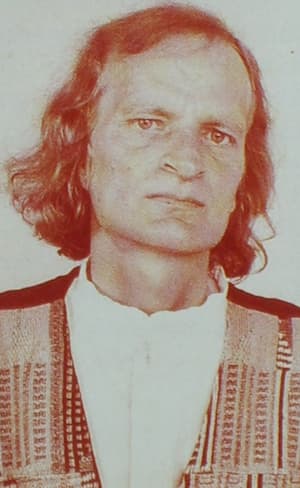
Florian talks to Edwin Pouncey at his Munich home 1 December 1995. Gerhard Augustin is also present. Due to sound quality of the tape, and the fact that English is not Florian's first language, much information has been conjectured and supplied in square brackets. The same goes for Gerhard's occasional interpolations, which have heen incorporated into Florian’s speeches.
FF - You have a saying in England 'no news is good news!' For me also! When I go to the studio, I never look in the letterbox, because it gives a bad feeling before [work] . And after the studio, it's also not possible, because I'm too tired, and I like to listen to music ...
EP - Do you have a superstition about that? Bad news might mess you about, affect your music.
FF - I'm not a football player! I have to go with a good feeling to the studio. When I go with a bad feeling to the studio I spend some [---] .. .it's not possible, it's not good for the team, because some other people are not so happy then. So I don't ever look at the letter box!
EP - What effect did Egypt have on your music, playing it there?
FF - It brought me an inspiring day! One day ... that's enough. I know what I want and what I have to do. I like a joke! If you want to tell someone you know how it goes, you want to show someone your direction and impose it on them ... sometimes a joke is better, to see it from the funny end. I used to listen to short-wave radio, to Oriental and Indian music. The time I ought this [radio] I have tears, because I was so happy to listen to the whole world. It's strange for my parents, because they [disapproved].
My intention with Popol Vuh is to keep the soul in tune with time! In tune ... on each level: a mystic level, a political level. I'm quoting from the bible .... some people ask me, do I like philosophy. I say, not any more. But I'm doing the things that are closest to me, that I feel closest to. That has always been my contemporary philosophy, so my philosophy changes with circumstances.
EP - Those early records as well had a very deep spiritual, nature feel about them.
GA - Have you ever been in England, Florian?
FF - Yes, I was very early in London in the 1960s .. .l met some people, the Crazy World of Arthur Brown. The London 'underground' [scene] ... the Pink Floyd.
EP - Did you see Yoko in her gallery?
FF - No, it was private. It was terrible. The doors had no locks on them; there was a chair. The chair was half. I had claustrophobia. I need closed doors. And so the first doors I (whoosh) opened them up and then no possible more come out this terrible woman out of the room.
EP - That half-chair was one of her exhibits.
FF - No, it was part of the interview. For my wife. She was Stern Magazine photographer. I was accompanying my wife. Later I write the words to it. This time I was looking at London. It was crazy. Every corner, somebody was standing, with new ideas about religion, or blah blah blah! My son likes London, for me it's too much!
EP - For everybody it's too much. I think London is like ... you either love it or can't bear it.
The story of Affenstunde
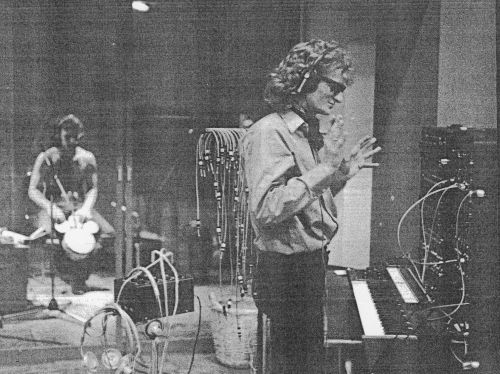
EP - That first record you made, you used a huge Moog synthesizer, Was that record designed for that instrument? Was the Moog bought first, then you thought - make a Moog Sound record?
GA - I should tell you the story. Before I came to United Artists in Germany I was working with UA in America and live in San Francisco, and I had worked with David Brown from Santana, on a Moog Synthesizer. So I came to Germany and I was specifically looking for someone in Germany that would have that kind of instrument. There were two people: Eberhard Schoener and Florian Fricke, who also happened to be direct neighbours out in the country. House to house! The only two people in Germany who had this very expensive instrument! A Moog Synthesizer was 65,000 Marks at the time. So I had this idea of doing an album. There was another guy - Walter Carlos . ..
FF - (He did it] just before. This was a record of Bach (for the synthesizer] ...
GA - We wanted to make an album, to create new sounds. Because I envisioned the possibilities of that instrument on a long run. I knew that it would eventually take its place alongside other instruments, by the ability to create certain technical sounds, which until that time were not possible.
That's where he (Florian) came in. We were introduced by another filmmaker who brought us together. Florian was in the process of doing this album, and it was extremely hard to fmd a company (to release it]. Not even my own company, when it was finished, wanted to go for it. We had to go through some strange changes! We took it to EMI in Cologne ... we went to another company in Hamburg, where the artists weren't allowed to come in the office! 'You guys have to stay outside, I just want to talk to your manager'.
Until today this is his most legendary album, of all the albums he did, just because it was so new, so different. It was done for the purpose of making a Moog Synthesizer (record]. At the beginning people did not accept it. Today we have had at least 55 different releases, in different countries and different labels. And other people have sampled this!
FF - It was a fantastic journey to learn this Moog synthesizer. I didn't have any papers -there was no manual for how to run that machine! He was angry [?] ... Robert Moog who invented the Moog. It was a strange beautiful journey.
EP - So you were improvising on this mysterious instrument, for which you had no manual to operate ... you were discovering sounds for yourself on that machine.
FF - We have made, day and night, music! I was always playing. I was working almost around the clock. Whenever I didn't sleep, I was just experimenting, trying to find ... Frank Fiedler was a very important man, especially at this time, he was there from the beginning. Later I come back to my old roots, back to the piano. I was learning piano music at high school. I was a good Mozart player.
EP - I'd very much like to hear that record.
FF - Gerhard will play it for you. The first piece is not so good, After that I'm very happy about it. I had only two days in which to make it.
The digital age
FF - I know what is possible to do, but I don't go .. .it's not my thing. But I know what I can do . It's [just] a different way to record. People think the computer makes the music now. [So] you can compose in the studio. Before you come to the studio you have to know what you want. It's very tricky to work with. I don't like it very much.
In the beginning I was (perceived as] an old genius - because it was not necessary [that] I know all about this (digital] material. People are very nice to me ... (they say] 'this man has had many music by himself recorded'. And so I have my reputation in a new digital studio, because for me it's like paranoia, all this. But they were very nice and now after five or six years I have a little bit of knowledge about this.
I work for a new style for the young generation, with soul. And so I can't do [records]like Hosianna Mantra (now] because this young generation, (you] play a little bit (to them] ... my daughter is 16, she says 'Oh Papa, beautiful, but never I will hear this!' And so because I'm a father and I like my children I take them very seriously. And so I listen to what they like. Some [of their music] I like very much! Techno. But [the surroundings] I don't like- the ecstasy, the lights, the volume ...
My son, he brings me London Ambient music. Very creative, very beautiful. Relaxed music, but without a nucleus. That's what Techno music lacks. And I make the nucleus. And other things I will do. I need it for my music and for my identity. And I think we go [further] to [making] a modern music than Techno.
[A tape of recent Popol Vuh material has been playing]
GA - What do you call this kind of music?
FF - It's not Ambient. It comes from the idea of the Ambient, but it's all music. Only, these people don't know anything about modern music ... .it's all (imitates sound of a bass drum) oomph, oomph, oomph ..
EP - Like all your music, this has a spirituality to it, in the mix.
FF - Perhaps I'm successful to have [made music] in all my life, perhaps unsuccessful...it's not important. . .! would try to find a music to bring soul to the people. That's all.
EP - I think this is very beautiful music.
FF - I don't know ...
GA - Because 'genuine' Popol Vuh fans, their reaction is very different from what you're saying now, because they are always in anticipation of something sacred that he may offer them.
EP - But that's living in the past, really.
FF - That's how I feel too, that's why I'm doing this contemporary feeling. I can tell you, last Sunday, in the evening before my son had his 21st birthday, out in the country in the house I was cooking a lot and then he comes with- I don't remember the name - [a record] from an Irish singer ... a girl. It wasn't Enya! It was all [virgin?], beautiful music. So I'm happy when I can see, it's [at] this time possible to make music not in this [style] (oomp, oomp, oomp). Techno or American Pop ... all music and beautiful music, they have a trance and then I'm happy, that's all.
EP - That's interesting how you can make a machine human in a way, making what is mechanical relate to somebody who is human- that is an art. Techno doesn't have it.
FF - [If you can do that] then you are a good producer.
GA - Some people think someone else discovered him, in actual fact I started working with him from the very first note he put on record. It's nice if you can keep that in mind somewhere. I read certain books, encyclopaedias, what do these people really know? I can't make my life any better than I have done. Credit should go where it's due.
EP - You have a very clear idea of what you want to do musically now?
FF - Because I know I'm no longer a young man, perhaps I don't have, I don't know, many years [left] ... and so I know about what I have to do. Like City Raga. I know I have some discussions [earlier] about new style and old style, but it's [futile?]. In imagination, you can have ... when I [was]25 years, make the same music like Hosianna Mantra, I'm crazy .. .l'm [happy] in life when I can change, transform, evolve .. .! need [rites] for transformation, perhaps it's my [force]. This [false] period of creation could be the application of human rights in music. The nucleus is the thing. It's not to say I'm better than when a young man but I know more now than I did then. I no longer compose on the piano. I compose here! (tapping his head). For a long time.
EP - Really? Wow. That's impressive. You can do it straight in your head. I watched a programme about Ennio Morricone yesterday -he did the same thing.
FF - It's necessary to be able to compose without. The instrument, when you can play an instrument...the fingers are sometimes quicker than your composer mind ....
Working with musicians
FF - ... Like from this harmony- connections, and I know that's not the right word ... and then I thought, I don't like these mixed American ham1onies. You have a clear chord and you do the second thing and then you have the mixed American chord. And for me .. .it's a decision of my conscience what kind of harmonies [to use] ... but we don't have fights [about it]!
GA - Interesting that on this current production that he had, one song was already completed, and after listening to it again and again, he thought it was like ... he erased the whole thing because it was too corny! You know ... it was against his belief.
FF - But we know this, it's not a problem. [working with people?] It's a beautiful thing. Sometimes before I have had some problems with this group, it's normal, but now is ... the best days of the week[?].
GA - Collaboration has been very continuous .. in terms of [for example] Frank Fiedler who's been there from the beginning ... and [Guideaux?] for the last six or seven years.
FF - That's a very great musician.
GA - He only exchanged the singer for example- Maja -on City Raga, she lives in Yucatan.
FF - They are all people that come to my life. I'm not looking for these kind of people ... they just drop into my life. Sometimes, [like with] Maja, I had not seen her for ten years, until all of a sudden she was there. Because I was working with Renate [Knaup], and then she was ... why, why are you working with Renate?
EP - So in a way, without you trying, you were attracting these people in a very natural way.
GA - That is the truth. Certain people come, whether it's Renate, Danny or myself: Florian is the nucleus, people are like satellites around him all of a sudden. They seem to collide, and that is what brings the explosion of creation. But they disappear again!
FF - I love her [Renate] very much, in a very deep [way]. I can't say about.. .I don't do this ... but just what I have done ... all melodies, five tones higher! · for Renate, and so no longer possible [for her] to scream, singing so high. So she comes back to her home roots. She comes from high in the mountains, she's a very down to earth girl. She can sing beautiful like Heidi ... Renate is my Heidi!
GA - Heidi is the incarnation of German corniness!
Influences
EP - When Popol Vuh started, were you interested in rock or did you find rock music boring?
FF - There was a little infection, some by The Beatles, some by The Stones, yes .. .like a flu! And later, Blind Faith! Indeed really no because when you really, from your young life, start to love music then you're looking for ... and it's not important what I say about rock or pop music, I have to look for my way in music to be ... and bring out. .. perhaps, my strange life, it's more with society. Because I have family and other commitments. [My circumstances are} not so nice, like a real rock musician, he lives [financially] from the mother and from the Social Aid, and from the dealing that's part of rock music. And I have family and I like to go the way of this music to my own end · true to myself. And I thought in this generation with rock music and nobody has knowledge about one eighth of these people. It was new. Sometimes I think - oh .. . and some people come from the political era in Germany, [particular] to the 1970s.
They have had absolutely [radical] ideas. They thought they invented the hole in the record! And in the end ... me and a friend [a revolutionary political activist] was standing before his store ... he makes his first meditation in a little room. We are singing ... and it was good.
EP - So right from those early days, you were a contemporary composer as opposed to a pop musician? You probably owed more to a modern avant-garde composer like Stockhausen, rather than The Beatles.
FF - Sometimes I think about this. There's only one person in Germany I like (except for Gerhard!), to sit together with him. It's Boris Becker! He's a good man. My son knows him. And he's sung for the disco. And the woman (his wife) Babs was inside ... beautiful girl, a half-black woman. It's great [that he married her]: in Germany that takes a lot of courage, it's a political thing.
GA - But when you are Boris Becker, who is such a national idol, he's allowed everything! People will accept anything he does, because they love him so much . Boris is really the nation's favourite in many ways. The press may put him down if he loses a couple of times in a row, but as a national [figure] he's a most loved hero.
FF - I love him. Like Werner Herzog! Werner has had some success and recognition internationally. But he still drinks his beer from the bottle (in other words he hasn't changed).
Only the work is the most important thing, and so we are friends!

 Die fortschrittlichste, ausgereifteste und vielleicht wichtigste deutsche Plattenproduktion will jedoch bis jetzt nich keine Plattenfirma veröffentlichen. Zu wenig expressiv, zu weit voraus, zu aleatorisch erscheint den bei Deutschlands etablierten Plattenfirmen angestellten